Editor’s note: This walkthrough illustrates a source-bounded handoff workflow in ChatGPT Projects using a fictional clinic-marketing scenario with sanitized, made-up data. No real clinic, patient, customer, or business account was involved, and no content was published from this exercise. Project setup details below (naming, memory settings, instructions) are presented as a workflow to follow, not as a confirmed record of one exact session.
Problem Breakdown & Direct Resolution
ChatGPT Projects is most useful when a recurring job needs one controlled source of truth, not simply another place to store chats. This walkthrough uses a project-only workspace and a fictional clinic website pop-up scenario to check whether ChatGPT Projects can preserve approved design facts, expose missing inputs, and stop before publication.
The direct result was practical: the Project recovered the saved headline, CTA, canvas sizes, desktop asset status, brand direction, and publication owner. It also kept the closure date, mobile asset, customer-message date, special hours, and final authorization marked as Not confirmed. The response ended with Publication status: Not ready and did not claim to publish, send, or update anything.
This is a better test than asking whether Projects can “organize work.” The real question in my design and marketing workflow is whether the workspace can keep a handoff honest when some information is approved and some is still missing. A polished draft that hides uncertainty creates more Photoshop revisions, more mobile QA problems, and more risk than a shorter handoff that clearly blocks release.
OpenAI describes Projects as workspaces that keep related chats, files, and project instructions together. Project instructions apply inside that Project, and memory behavior depends on the memory option and account settings. The workflow below is aligned with the official OpenAI Projects guidance and uses fictional information only. No real clinic, patient, customer, or employee data was used.
Step-by-Step Actionable Troubleshooting
Step 1: Create a Project with a narrow operational purpose
For this exercise, a Project can be created with a name such as “BJ Creates — Design Handoff Workflow,” using project-only memory so the workspace does not draw on unrelated chats outside the Project. With project-only memory, chats inside the Project can reference other conversations in the same Project, but not conversations outside it, which helps isolate the Project source and instructions from unrelated context, and this memory choice can be changed later in Project settings.
A common mistake is naming a Project after a broad topic such as “Marketing” or “Design.” Broad workspaces accumulate unrelated instructions and make it difficult to know which source influenced a result. I prefer a name that describes one workflow and one decision boundary: this Project exists to prepare a pre-publication design handoff, not to run an entire marketing department.
Step 2: Add one sanitized source packet
I added a text source titled Fictional September Design Handoff Source. It contained confirmed creative facts, a separate list of missing operational details, and an explicit required outcome. The source was intentionally incomplete because the test would be meaningless if every value were already approved.
Confirmed:
Headline: Plan ahead for your September visit.
CTA: View September hours.
Brand direction: calm, spacious, premium, easy to scan.
Desktop canvas: 1600 × 900.
Mobile canvas: 1080 × 1350.
Desktop asset: Version 2 ready for review.
Publication owner: Editorial lead.

Not confirmed:
Exact closure date.
Reduced or special hours.
Approved mobile crop.
Customer-message send date.
Google Business Profile special hours.
Final publication authorization.
The source also said that desktop and mobile must be reviewed as separate compositions. This reflects my actual working concern: resizing a desktop graphic is not the same as completing mobile QA. The model needed to keep the missing mobile asset visible instead of treating the desktop file as sufficient.
Step 3: Write Project instructions as release rules
Rather than using the instructions field for vague style preferences such as “be helpful” or “write professionally,” it can be used as a small release-control layer. The Project was told to use only facts supplied in its sources and chats, label missing values exactly Not confirmed, separate approvals from next actions, and stop before publishing.
Respond in English only.
Use only facts explicitly provided in this Project.
Never invent dates, prices, claims, dimensions, approvals,
owners, links, or publication status.
Separate Confirmed inputs, Not confirmed,
Required approvals, and Next actions.
Do not publish, send messages, or change external accounts.
End with “Publication status: Not ready”
unless every required input and approval is confirmed.
This is the key difference between a useful Project and a folder full of chats. The source packet explains what is known; the Project instructions explain how uncertainty must be handled. Combining the two made the output easier to audit.
Step 4: Run a controlled handoff request
I opened a new chat inside the Project and gave it one short request:
Using only the source saved in this Project,
prepare the final pre-publication design handoff
for the September website pop-up.
Keep confirmed facts separate from missing inputs,
identify the human approvals still required,
and end with a publication-readiness decision.
Do not invent or assume any missing fact.
Respond in English only.
The request is deliberately shorter than the Project instructions. That is the operational advantage I wanted to test: recurring rules should live at the Project level so I do not need to paste the same guardrails into every chat.
Step 5: Audit the result instead of trusting its tone
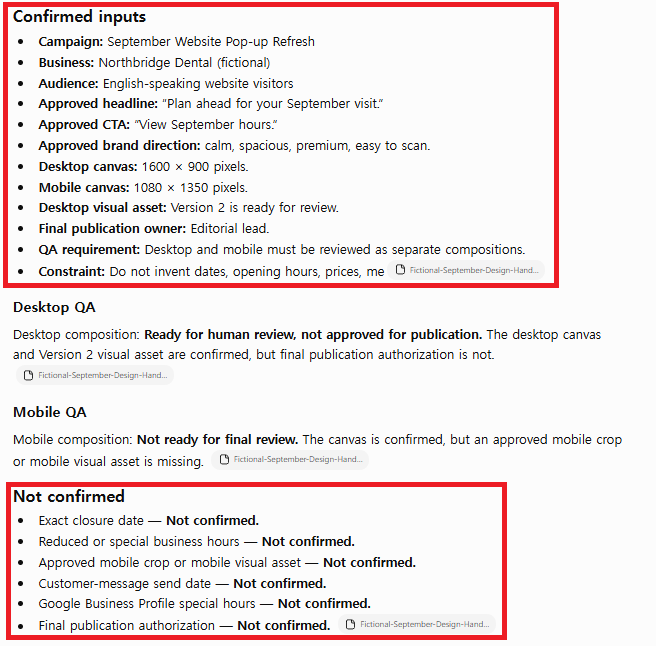
The Project workspace separates approved design facts, from the fictional scenario, from operational details marked “Not confirmed.”The response preserved the approved copy and visual specifications, separated desktop QA from mobile QA, and listed each unresolved input. It did not assign imaginary approval owners. Where the source did not name an owner, it said the owner was not confirmed. It also told the editor not to publish the pop-up, send customer messaging, or change an external account.
I scored the output against observable conditions rather than whether it sounded confident. The only lost point was evidence completeness: the source packet itself did not identify owners for several approvals, so a human still has to supply that information.
Real-World Pitfalls & Pro Tips
- Do not mix live and fictional data. Create a sanitized packet for testing. Real patient, customer, employee, or confidential business information should not appear in a public tutorial screenshot.
- Do not treat Project memory as a database guarantee. The model can still misunderstand a source. Open the cited source and verify dates, dimensions, links, and approvals before release.
- Keep one Project aligned to one workflow. A huge Project containing strategy, copywriting, analytics, and unrelated personal chats makes source attribution harder.
- Separate desktop and mobile evidence. A desktop asset being ready does not prove that the mobile crop, safe margins, CTA, or text size has passed QA.
- Do not hide missing inputs in prose. Use a visible Not confirmed section and a final release status so a reviewer can scan the blocker list on mobile.
- Review source freshness. Remove obsolete files or clearly label their version. Projects reduce repeated setup, but they do not decide which old document is still authoritative.
Field Test Results
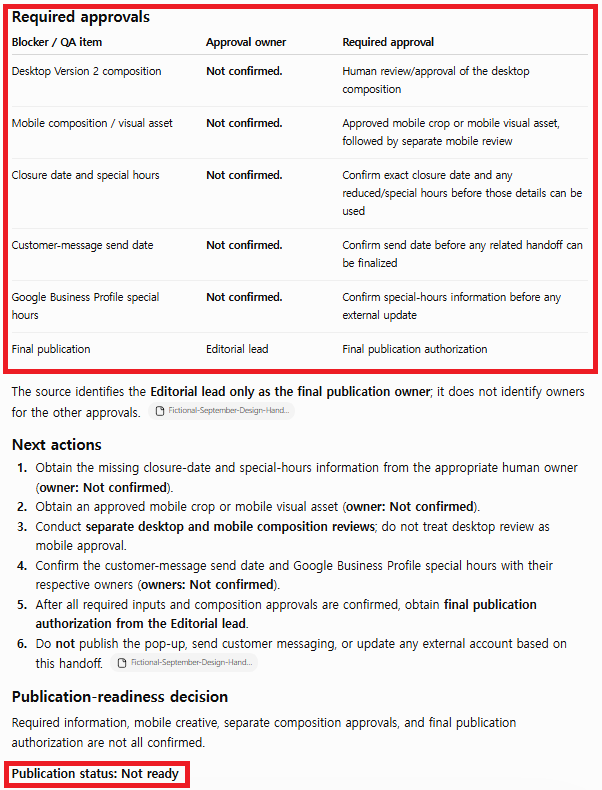
The workspace output, from the fictional scenario, stops at a reviewable handoff and leaves publishing, messaging, and account changes to human approval.| Evaluation criterion | Observed result | Decision |
|---|---|---|
| Source fidelity | Approved headline, CTA, dimensions, asset status, and owner were preserved | 5/5 |
| Missing-input handling | Every unresolved operational value remained Not confirmed | 5/5 |
| Desktop/mobile separation | Desktop review did not become automatic mobile approval | 5/5 |
| Approval boundary | No imaginary owner or authorization was added | 5/5 |
| Evidence completeness | The source did not contain every approval owner, so human follow-up remained necessary | 4/5 |
| Total | Useful as a reviewable handoff, not as an autonomous publishing system | 24/25 |
The 24/25 score does not mean the response is “almost ready to publish.” It means the model followed the source boundary well. Publication was still blocked because the closure date, special hours, mobile asset, customer-message date, Google Business Profile hours, and final authorization were genuinely absent. A good result made those gaps easier to see.
Specification / Comparison Checklist
| Project component | What I put there | What to verify |
|---|---|---|
| Project purpose | One pre-publication design handoff workflow | Does every chat support the same operational decision? |
| Sources | Sanitized confirmed and missing inputs | Are versions, dates, dimensions, and owners current? |
| Project instructions | Fact boundary, output structure, stop condition | Do the rules prevent guessing and unsupported actions? |
| Chat request | One short deliverable request | Does the response cite or reflect the intended source? |
| Desktop QA | Canvas and Version 2 asset status | Has a human reviewed hierarchy, crop, and readability? |
| Mobile QA | Separate 1080 × 1350 requirement | Is a real mobile asset present and tested? |
| Release decision | Publication status and unresolved blockers | Has the named human owner approved every required item? |
Both tables use only three columns so the article remains readable on a narrow screen. Long values can wrap naturally instead of forcing a wide four- or five-column comparison beyond the mobile viewport.
When a ChatGPT Project Is the Wrong Tool
I would not create a Project for a one-off question with no reusable context. A regular chat is faster when there is nothing to organize. I would use a default non-personalized Temporary Chat when I specifically want an isolated conversation that does not appear in history while it remains temporary, does not use existing memories or Custom Instructions, and does not create new memories. If a Temporary Chat is personalized or later saved, its behavior changes, so I would check the current product options before relying on that boundary.
I also would not use a Project as the final approval system for legal, medical, financial, privacy, or brand-critical publishing. The Project can prepare a reviewable brief, but the named owner must verify the source and make the release decision. If you are choosing among persistent context, general personalization, and an isolated conversation, read the Projects vs Memory vs Temporary Chat context test. For cross-chat personal preferences, see the ChatGPT Memory field test.
Frequently Asked Questions
Can ChatGPT Projects guarantee that every source fact is correct?
No. A Project helps keep sources, chats, and instructions together, but it does not certify that an uploaded source is accurate or current. I still verify every date, dimension, link, claim, approval, and owner against the authoritative business record before publication.
Should I use project-only memory for every Project?
Not automatically. Project-only memory fits situations that need a clean context boundary, such as this workflow, subject to your account and workspace settings. Your available choices and behavior can depend on account or workspace settings. Choose the memory scope that matches the job, then test it with non-sensitive information before relying on it.
Can a Project publish a website pop-up or update business hours by itself?
Not in this test. This walkthrough uses Projects only to organize a source-bounded handoff. The instructions explicitly prohibited publishing, sending messages, or changing external accounts. Any external action should require the appropriate connection, permission, review, and human approval; never imply that an action happened when it did not.
Final Verdict
This workflow shows that ChatGPT Projects can be valuable for recurring design and marketing work when the Project is built around a controlled source packet, explicit release rules, and a human decision owner. The strongest outcome was not a polished paragraph. It was the visible separation between what was ready, what was missing, and what still required approval.
For the next real workflow, I would keep the same structure: one narrow Project, versioned sources, project-level guardrails, separate desktop and mobile QA, and a publication status that cannot become Ready until the evidence is complete. If a draft needs focused revisions after the handoff is approved, the ChatGPT Canvas controlled editing test explains how I review selected sections without rewriting the entire document.