Tag: Productivity

  • How to Use ChatGPT Canvas (2026 Guide): Writing, Coding & Editing

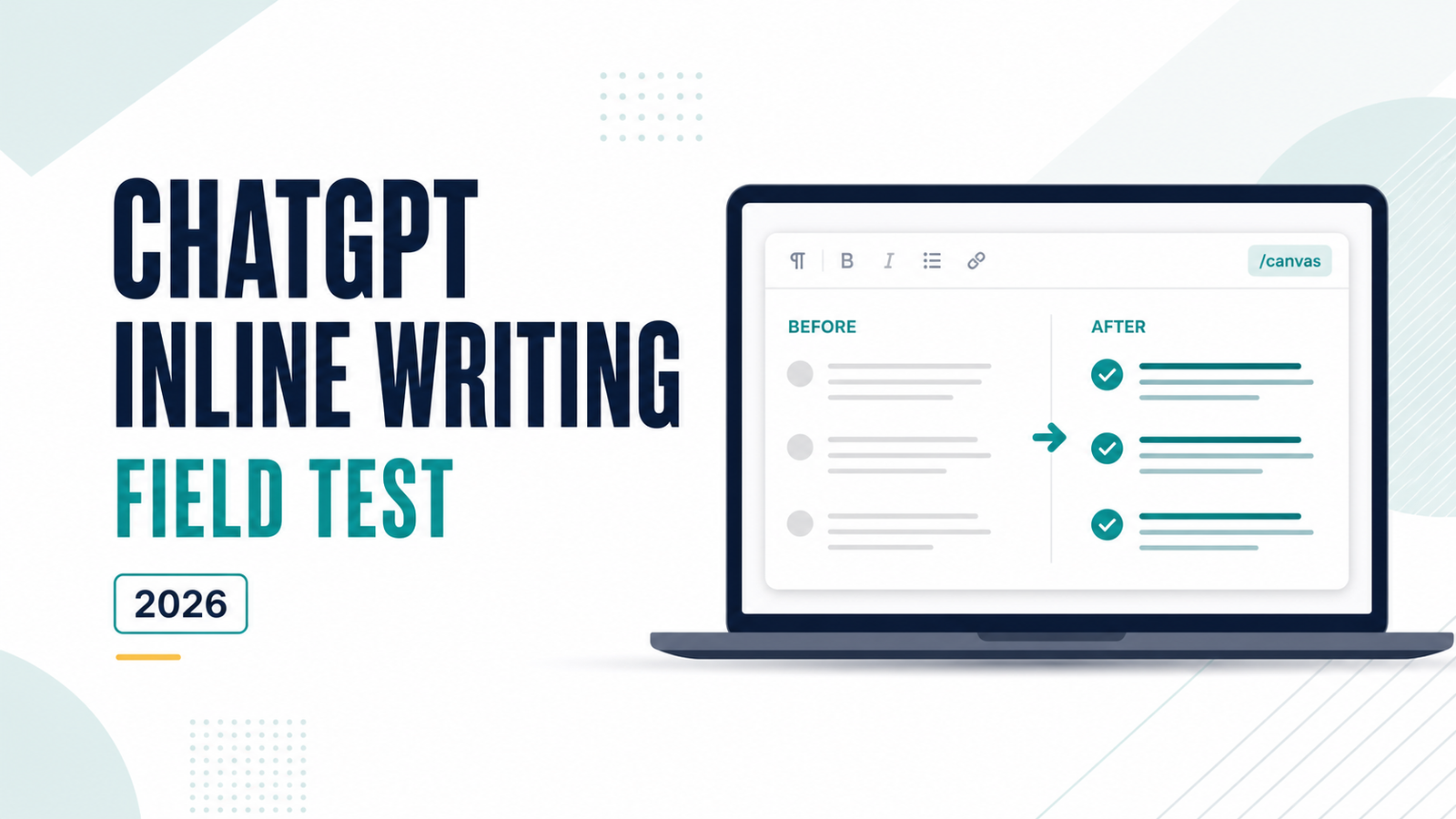
    How to Use ChatGPT Canvas (2026 Guide): Writing, Coding & Editing

    ChatGPT is useful for generating a first draft, but many writing and coding tasks require more than a single answer. You may need to revise one paragraph, compare versions, fix a small section of code, or export the finished work without rebuilding everything in another editor.

    ChatGPT Canvas is designed for this kind of iterative work. It places your document or code beside the conversation, so you can edit directly, ask for targeted changes, and review suggestions without losing the larger context.

    In this guide, you will learn how to open ChatGPT Canvas, use it for writing and coding, create better revision prompts, understand its limitations, and decide when a regular chat is still the better option.

    Quick answer

    To use ChatGPT Canvas, ask ChatGPT to “open a canvas,” choose Canvas from the tools menu, or type /canvas when the command is available. Use the side-by-side workspace to edit text or code directly, highlight a specific section for focused feedback, review changes, and download the finished file.

    What Is ChatGPT Canvas?

    ChatGPT Canvas is an editing workspace for writing and coding projects that need repeated revision. Instead of treating every request as a separate chat response, Canvas keeps the working document visible while you and ChatGPT improve it.

    You can type directly into the document, highlight a sentence or code block, ask a question about that selection, and apply or reject suggested changes. This makes Canvas especially useful when the task has a structure you want to preserve.

    According to OpenAI, Canvas is available on the web and the Windows and macOS desktop apps. Mobile availability can differ, so check the current interface if you do not see the option on a phone or tablet.

    ChatGPT Canvas vs. a Regular Chat

    FeatureRegular chatCanvas
    Best forQuestions, brainstorming, and short outputsDocuments or code that need multiple revisions
    EditingUsually generates another complete responseLets you edit and revise the working content directly
    Focused changesYou must describe the target section carefullyYou can highlight the exact text or code
    Change reviewCompare messages manuallyUse version history and show changes
    ExportCopy and paste the responseDownload documents or code files

    A regular chat is faster for a quick explanation or a short list. Canvas becomes more valuable when you already have a draft and want controlled changes instead of a completely new answer.

    How to Open ChatGPT Canvas

    Method 1: Ask for Canvas in your prompt

    Start a normal ChatGPT conversation and state both the task and the workspace you want:

    Open a canvas and help me draft a 700-word project proposal.
    Use clear headings, a professional tone, and a short action plan.

    ChatGPT may also open Canvas automatically when it recognizes a longer writing or coding task.

    Method 2: Use the tools menu

    Open the tools menu near the message composer and select Canvas if it appears. Depending on the interface, typing / and choosing the Canvas command may also open a new workspace.

    Method 3: Move existing content into Canvas

    If you already have a draft, paste it into a conversation and use the available “open in canvas” shortcut. You can also open a blank Canvas first and paste the draft into the workspace.

    A Practical Writing Workflow

    Consider a realistic situation: you have written a client update email, but the introduction sounds defensive and the next steps are difficult to scan. Asking ChatGPT to “make it better” may rewrite too much. Canvas lets you revise the problem areas while preserving accurate dates, names, and commitments.

    Step 1: Define what must not change

    Open this draft in Canvas. Improve clarity and tone, but do not
    change any dates, prices, product names, or promised deliverables.
    Keep the final email under 350 words.

    This instruction gives ChatGPT useful boundaries. It is safer than requesting a broad rewrite when the document contains details that must remain exact.

    Step 2: Select one section

    Highlight the introduction and request a focused change:

    Rewrite only this introduction so it sounds calm and accountable.
    Keep it to three sentences and do not add an apology we have not approved.

    The important result is not simply smoother wording. The revision should preserve the original facts, reduce unnecessary defensiveness, and match the audience. If ChatGPT introduces a new promise or removes a key limitation, reject or edit that suggestion.

    Step 3: Improve structure

    Convert the next-steps section into three bullet points.
    Each bullet should begin with the responsible person, followed by
    the action and deadline. Do not invent missing owners or dates.

    This prompt asks for a structural improvement while explicitly preventing fabricated details.

    Step 4: Run a final accuracy check

    Review the full draft. List any sentence that contains a factual
    claim, date, number, commitment, or assumption that I should verify.
    Do not rewrite the document yet.

    Separating verification from rewriting makes the review easier to control. You remain responsible for checking the final content before sending or publishing it.

    Useful Canvas Tools for Writing

    • Suggest edits: adds targeted comments instead of silently replacing the entire draft.
    • Adjust length: shortens or expands the document while keeping its main structure.
    • Change reading level: adapts the complexity for a different audience.
    • Add final polish: reviews grammar, clarity, and consistency.
    • Version history: lets you return to an earlier version if a revision makes the draft worse.
    • Show changes: displays additions and deletions so you can review what changed.

    Automatic polish is useful, but it should not replace judgment. A shorter draft can omit an important qualification, and a simpler reading level can remove necessary technical precision.

    How to Use Canvas for Coding

    Canvas can also help you review, explain, and revise code. You can select a function, request comments, ask for a bug fix, or convert code to another language.

    Review this function for correctness and edge cases.
    First explain the problem without changing the code.
    Then propose the smallest safe fix and add two test cases.

    This sequence is more informative than clicking “Fix bugs” immediately. It shows the reasoning, limits the scope of the change, and gives you tests that can reveal whether the fix works.

    OpenAI currently documents browser-based execution for Python code in Canvas. React and HTML previews run in a sandboxed environment, but external packages or web resources may depend on network-access settings. Do not assume that a successful preview proves the code is secure or production-ready.

    How to Export or Share a Canvas

    When the draft is ready, use the Download option in the Canvas toolbar. General documents can be exported as PDF, Markdown, or Word files. Code canvases can be downloaded with a file extension that matches the detected language.

    Sharing is also available, but review the content before creating a shared link. Remove private names, credentials, client details, unpublished plans, and any information that the recipient should not receive.

    Canvas Privacy and Web-Safety Considerations

    A Canvas document is still part of your ChatGPT activity. Before adding sensitive material, review your account settings and the organization’s rules for AI tools. Our ChatGPT Data Controls guide explains how model training, history, Memory, exports, and Temporary Chat differ.

    Web previews require additional care. Rendered HTML or React content may attempt to communicate with third-party services. OpenAI may ask for confirmation before allowing an unknown external connection. Only approve a connection when you understand the destination and why the preview needs it.

    • Never paste passwords, API keys, private access tokens, or confidential customer records into a Canvas.
    • Review generated links and network requests before allowing external communication.
    • Test code in an appropriate development environment before using it in production.
    • Check every factual claim and citation in a writing project.

    Common ChatGPT Canvas Mistakes

    Requesting a full rewrite for a small problem

    If only one paragraph needs work, select it. A full rewrite creates more facts and wording to verify.

    Applying every suggestion automatically

    A polished suggestion can still be inaccurate, too confident, or inconsistent with your goal. Review the change before applying it.

    Using vague instructions

    “Improve this” does not define success. Specify the audience, goal, tone, length, facts to preserve, and the exact section that needs attention. For a broader framework, see our guide to writing better ChatGPT prompts.

    Treating the preview as a final test

    A Canvas preview is useful for iteration, but it does not replace accessibility testing, security review, browser testing, or deployment checks.

    A Reusable Canvas Prompt Template

    Open a Canvas for [document or code type].
    
    Goal: [what the finished work must accomplish]
    Audience: [who will read or use it]
    Preserve: [facts, terminology, structure, or behavior that must not change]
    Improve: [the exact problem to solve]
    Constraints: [length, tone, deadline, format, platform, or coding requirements]
    
    Before editing, identify any missing information or risky assumptions.
    Make the smallest useful revision first, show the changes, and wait
    for my review before rewriting other sections.

    This template encourages controlled revisions. It also asks ChatGPT to surface missing information before it starts changing the project.

    Frequently Asked Questions

    Is ChatGPT Canvas free?

    OpenAI has made Canvas available across multiple ChatGPT plans, but feature access, models, and usage limits can change. Check the tools available in your current account.

    Can I use Canvas on mobile?

    OpenAI currently lists Canvas for the web, Windows, and macOS and describes mobile support as coming later. Availability may change after this guide is published.

    Can Canvas run code?

    Canvas can execute Python code in the browser and can render React or HTML previews. Other languages may be edited and exported, but execution support is not the same for every language.

    Does Canvas save earlier versions?

    Yes. The version controls allow you to move through earlier versions, restore prior work, and show additions and deletions.

    When should I use Projects with Canvas?

    Canvas is the editing workspace, while Projects helps organize related chats, files, and instructions. If the work continues over multiple sessions, combine Canvas with the workflow in our ChatGPT Projects guide.

    Official Source

    Final Thoughts

    ChatGPT Canvas is most useful when you want to improve a document or code project without repeatedly replacing the entire draft. The best workflow is selective: define what must stay accurate, revise one section at a time, review the changes, and verify the final result outside ChatGPT when the task carries real consequences.

    Start with a small project, such as improving one email or reviewing one function. Once you understand how highlighting, suggestions, version history, and exports work, Canvas can become a practical bridge between brainstorming and a finished deliverable.

  • How to Use ChatGPT Scheduled Tasks (2026 Guide)

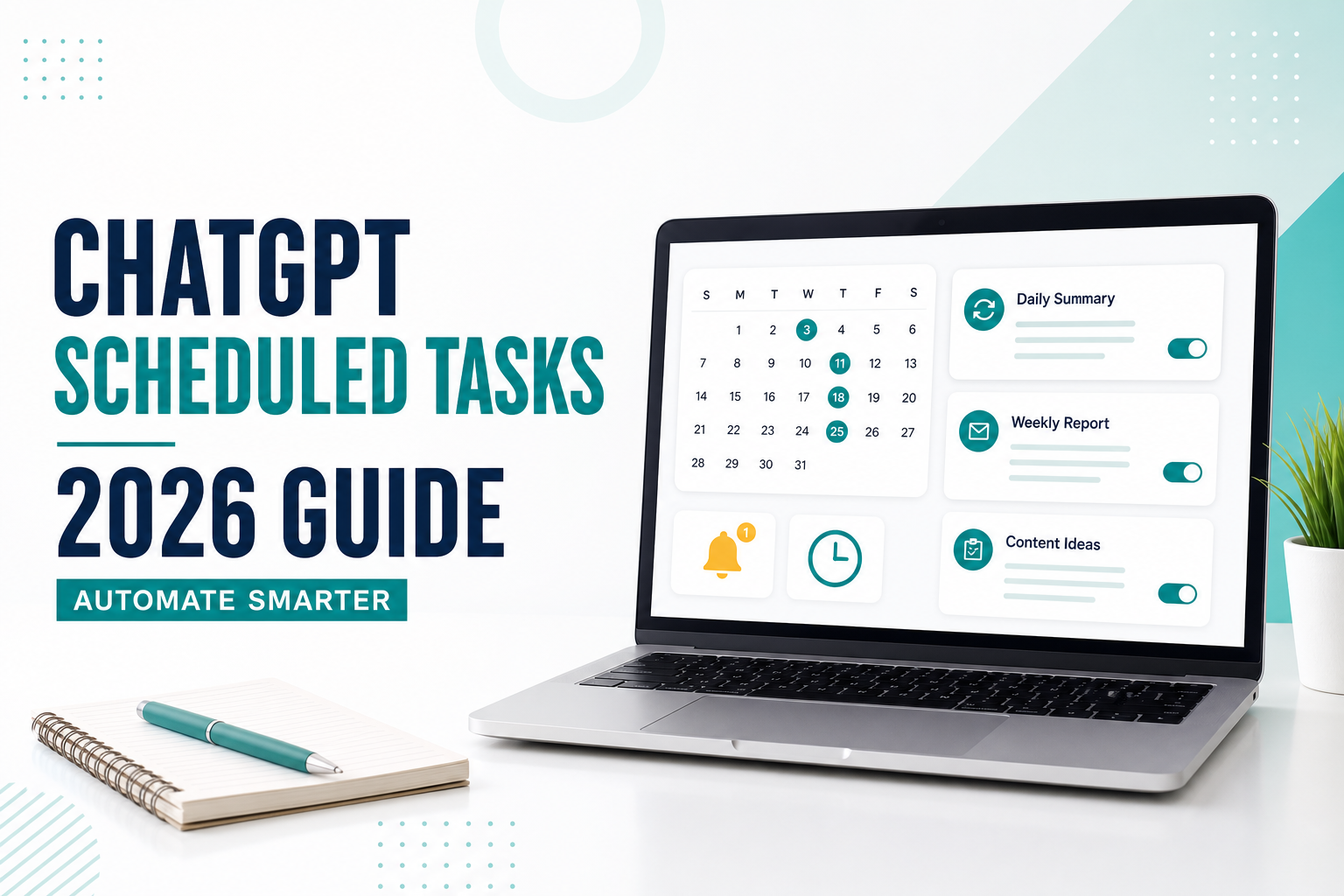
    How to Use ChatGPT Scheduled Tasks (2026 Guide)

    ChatGPT can answer a question now, but some jobs are more useful when they happen later. ChatGPT Scheduled Tasks can remind you about a deadline, run a recurring prompt, or check for a meaningful change and notify you when there is something worth reviewing.

    The feature is useful for routines such as a Monday planning prompt, a one-time follow-up reminder, or a periodic monitoring request. It is not a replacement for a calendar, an emergency alert system, or a fully automated business workflow.

    In this guide, you will learn how to create and manage ChatGPT Scheduled Tasks, write clearer task instructions, understand the current limits, and review the results safely.

    Quick answer

    Open the Scheduled page in the ChatGPT sidebar on the web or mobile app, create a new task, describe what should happen and when, then review the confirmation. You can later edit, pause, resume, or delete the task from the Scheduled page.

    What Are ChatGPT Scheduled Tasks?

    ChatGPT Scheduled Tasks let ChatGPT perform an instruction at a future time or on a recurring schedule. According to OpenAI, tasks can also monitor for a change and notify you only when there is a meaningful update.

    There are three useful task patterns:

    • One-time tasks: remind you about a specific event or follow-up.
    • Recurring tasks: run the same instruction daily, weekly, or on another schedule.
    • Monitoring tasks: periodically check for a change and report only when the condition is met.

    This is different from a normal ChatGPT conversation. A normal chat waits for your next message. A scheduled task can run later and deliver a notification through the options available in your account.

    How to Create a Scheduled Task in ChatGPT

    Step 1: Open the Scheduled Page

    Sign in to ChatGPT on the web or mobile app and select Scheduled from the sidebar. OpenAI says the Scheduled page is not currently available in the ChatGPT desktop app or Codex app.

    Step 2: Create a New Task

    Select the option to create a task. You can also ask ChatGPT directly to schedule something, such as a future reminder.

    Step 3: Describe the Outcome and Schedule

    Include the task, timing, time zone, output format, and the condition for sending a notification. A clear instruction reduces ambiguity.

    Every Monday at 8:30 AM Eastern Time, ask me to list my three most important work goals for the week. Then turn my response into a short plan with one next action for each goal. Keep the plan under 200 words.

    Step 4: Review the Confirmation

    Check the task name, schedule, time zone, and instruction before relying on it. If the timing is unclear, edit the task rather than assuming ChatGPT interpreted it correctly.

    Step 5: Enable the Notifications You Want

    Task updates can use the notification options available in your ChatGPT settings, such as push notifications or email. Browser and mobile operating-system permissions may also need to be enabled.

    How to Manage ChatGPT Scheduled Tasks

    The Scheduled page shows your tasks and their next run times. Open a task to review its previous result or use its controls to edit, pause, resume, or delete it.

    You can also reach task management from ChatGPT settings under Notifications and Manage tasks. OpenAI notes that deleting the chat associated with a task automatically pauses that task. Deleting a task, however, does not delete its associated chat.

    7 Practical ChatGPT Scheduled Task Examples

    1. Create a One-Time Follow-Up Reminder

    Remind me on July 24 at 10:00 AM Pacific Time to follow up with the design team about the homepage review. In the reminder, include these three questions: Is the mobile layout approved? Are the final images ready? Is the launch date still realistic?

    This is more useful than a vague “remind me later” request because it includes the exact time, time zone, subject, and follow-up questions.

    2. Run a Weekly Planning Check-In

    Every Friday at 4:00 PM, ask me to review this week. Ask one question at a time about completed work, unfinished work, and the main blocker. After I answer, create a five-item plan for next week. Do not invent tasks I did not mention.

    The instruction controls the conversation sequence and prevents the task from producing a generic plan before receiving your input.

    3. Prepare a Daily Priority Prompt

    Every weekday at 8:15 AM, ask me for today's meetings, deadlines, and available focus time. Then suggest three priorities in a table with columns for priority, reason, and first action. Label every assumption.

    This example makes ChatGPT wait for current information instead of pretending it already knows your schedule.

    4. Monitor a Public Page for a Meaningful Change

    Check the official page at [URL] every weekday afternoon. Notify me only if the eligibility requirements or application deadline changes. In the update, quote the changed section briefly, include the page link, and state when you checked it. Stop after August 31.

    Use an official source and define exactly what counts as a meaningful change. Still open the source yourself before making an important decision because an AI-generated update can be incomplete or incorrect.

    5. Get a Recurring Learning Prompt

    Every Tuesday and Thursday at 7:00 PM, give me one beginner-level question about spreadsheet formulas. Wait for my answer before explaining it. Keep each session under 10 minutes and increase the difficulty only after two correct answers.

    For longer guided practice, you can also learn how to use ChatGPT Study Mode.

    6. Review a Recurring Business Process

    On the first business day of each month at 9:00 AM, ask me for the previous month's support metrics. After I provide them, summarize the three largest changes, ask two questions about possible causes, and create a short list of items that require human review. Do not make recommendations until I answer.

    This prompt separates data collection, analysis, and decisions. That makes the result easier to review than a request that asks the AI to make an immediate recommendation.

    7. Schedule a Project Checkpoint

    Every Wednesday at 2:00 PM, ask me for the current status of the website redesign, the next milestone, and any blocker. Convert my answers into a short status update with sections for Completed, Next, Risks, and Decisions Needed.

    If the work spans many chats, learn how to organize the related material with ChatGPT Projects. However, OpenAI currently states that a task created in a project cannot access that project’s files.

    A Practical Prompt Test: Vague vs. Structured

    To test whether a scheduled-task prompt is clear enough, compare these two versions.

    Vague prompt

    Give me an AI news update regularly.

    Structured prompt

    Every Wednesday at 9:00 AM Eastern Time, summarize up to five important AI product announcements published during the previous seven days. Prioritize official company announcements and original documentation. For each item, include the announcement date, a two-sentence summary, and a source link. Clearly label rumors or secondary reporting and do not include an item without a source.

    How to interpret the difference: the vague version leaves the schedule, time zone, scope, source standard, length, and review criteria undefined. The structured version gives ChatGPT a repeatable process. It still does not guarantee that every summary or link is correct, so open important sources before using the result.

    A Simple Formula for Better Scheduled Task Prompts

    A useful scheduled-task instruction usually contains six parts:

    1. Action: What ChatGPT should do
    2. Schedule: Exact day, time, frequency, and time zone
    3. Input: What information or source it should use
    4. Output: Required format, length, and audience
    5. Quality check: What must be verified or labeled
    6. Stop condition: When monitoring or repetition should end

    Reusable template

    Every [schedule and time zone], [perform the action]. Use [input or source]. Return the result as [format and length] for [audience]. Verify or label [important facts and assumptions]. Notify me only when [condition]. Stop when [end condition].

    Clear preferences can also improve ordinary conversations. See our guide to ChatGPT Custom Instructions, but do not store confidential or task-specific information in permanent instructions.

    Current Limitations You Should Know

    • Plan limits apply: the number of active tasks varies by ChatGPT plan.
    • Frequency is limited: OpenAI says tasks cannot run more than once per hour.
    • Some tools are unsupported: voice chats and GPTs do not currently work with Tasks.
    • Project files are not available to the task: a task created inside a project cannot access the project’s files.
    • Deleting the associated chat pauses the task: check the Scheduled page if a task unexpectedly stops.
    • Apps depend on access and permissions: connected services may be unavailable or may require approval, especially in managed workspaces.
    • Tasks do not currently support webhooks: they are better suited to recurring check-ins than precise event-triggered automation.

    Availability and limits can change. Confirm the current details in the official OpenAI Scheduled Tasks guide before choosing a plan or building an important workflow around the feature.

    Privacy and Accuracy Tips

    • Do not place passwords, private client data, health information, payment details, or confidential company material in a task instruction.
    • Use official sources for monitoring tasks and open the source before acting on an important update.
    • Include a time zone whenever timing matters.
    • Define a stop condition for temporary monitoring tasks.
    • Review names, dates, figures, links, and assumptions in every result.
    • Use a normal calendar or dedicated alerting system for critical reminders that cannot be missed.

    OpenAI also warns that ChatGPT can produce incorrect or misleading answers. Treat task results as drafts or alerts to review, not as automatically verified facts.

    Frequently Asked Questions

    Are ChatGPT Scheduled Tasks free?

    OpenAI currently lists Scheduled Tasks for Plus, Pro, Business, and Enterprise users globally. Availability and active-task limits depend on the plan, so check the official help page for the current details.

    Can ChatGPT Scheduled Tasks send notifications?

    Yes. Depending on your settings and device permissions, task updates can use available push or email notifications.

    Can a scheduled task use files from a ChatGPT Project?

    No. OpenAI currently states that a task created in a project cannot access the files stored in that project.

    Why did my scheduled task pause?

    A task may pause after inactivity, when it needs additional action, or when its associated chat is deleted. Open the Scheduled page to review, edit, or resume it.

    Are Scheduled Tasks the same as ChatGPT Projects?

    No. Projects organize related chats, files, and instructions. Scheduled Tasks run an instruction later or repeatedly. The two features can support the same workflow, but they serve different purposes and project files are not currently available to Tasks.

    Can I use Tasks for important business decisions?

    You can use Tasks to collect reminders, draft summaries, or surface information for review. Do not let an unchecked result make a financial, legal, hiring, safety, or other high-impact decision. Verify important information with primary sources and qualified people.

    Final Thoughts

    ChatGPT Scheduled Tasks are most useful when the instruction is repeatable, the timing is clear, and the result can be reviewed before action is taken.

    Start with one low-risk task, such as a weekly planning check-in or a noncritical reminder. Include the time zone, output format, verification rule, and stop condition. After the first run, inspect the result and adjust the instruction before adding more tasks.

    For more workplace ideas, read How to Use ChatGPT for Work. Better instructions make both ordinary chats and scheduled workflows easier to review and more useful.

  • How to Use ChatGPT Custom Instructions (2026 Guide)

    How to Use ChatGPT Custom Instructions (2026 Guide)

    Repeating the same preferences in every ChatGPT conversation wastes time. You may keep asking for concise answers, beginner-friendly explanations, a specific writing tone, or a certain output format. ChatGPT Custom Instructions let you save those preferences once so they can shape future responses automatically.

    However, useful custom instructions are not a long biography or a collection of vague wishes. They should give ChatGPT clear, reusable guidance without including private information that does not belong in every conversation.

    In this guide, you will learn how to turn on ChatGPT Custom Instructions, what to write, how they differ from Memory, and how to test whether your instructions actually improve the result.

    Quick answer

    Open ChatGPT, go to Settings → Personalization → Custom Instructions, turn on customization, and add short guidance about your role, goals, preferred tone, and response format. Avoid passwords, confidential work details, financial information, or anything you would not want considered across multiple chats.

    What Are ChatGPT Custom Instructions?

    Custom Instructions are account-level preferences that tell ChatGPT what it should consider when responding. Instead of writing “Use plain English and give me a checklist” in every new chat, you can save that preference in your settings.

    According to the official OpenAI Custom Instructions guide, the feature is available on all plans on the web, desktop, iOS, and Android. OpenAI also states that the longer text fields have a 1,500-character limit.

    Custom Instructions are most useful for preferences that remain relevant across many conversations, such as:

    • Your general role or experience level
    • The audience you usually communicate with
    • Your preferred tone and level of detail
    • A response structure you use repeatedly
    • Rules such as explaining jargon or identifying uncertainty

    Custom Instructions vs. Memory

    Custom Instructions and Memory can both personalize responses, but they serve different purposes.

    FeatureCustom InstructionsMemory
    Who adds the information?You write and edit explicit guidanceChatGPT may remember useful details from conversations
    Best forStable rules, tone, role, and output preferencesPersonal details and context that may develop over time
    ControlYou can directly edit or delete the textYou can review, correct, or delete saved memories
    Example“Use plain English and end with next steps.”Remembering that you are preparing for a specific exam

    Use Custom Instructions when you know exactly what guidance should apply repeatedly. Use a normal prompt when the requirement belongs only to one task. If you want ChatGPT to carry useful preferences across conversations without manually rewriting every rule, read our ChatGPT Memory guide. Custom Instructions can still affect Temporary Chat, while Memory behaves differently; our Memory vs Temporary Chat guide explains how these controls work together. If you want a dedicated workspace with its own files and instructions, read our guide to using ChatGPT Projects.

    How to Turn On ChatGPT Custom Instructions

    On the web or desktop app

    1. Open ChatGPT and sign in.
    2. Select your profile icon and open Settings.
    3. Choose Personalization.
    4. Open Custom Instructions.
    5. Turn on customization and enter your instructions.
    6. Save the changes and start a test conversation.

    On iPhone or Android

    1. Open the ChatGPT mobile app.
    2. Open Settings.
    3. Select Customize ChatGPT.
    4. Enable customization and add your instructions.

    Menu wording can change as the app is updated. If you do not see the option, update the app and look under Settings or Personalization.

    A Reusable Custom Instructions Template

    A strong setup usually covers four things: context, goals, response preferences, and boundaries. Copy the template below and replace the brackets.

    I am a [role or experience level] who mainly works on [typical tasks].
    
    My usual audience is [audience]. My main goals are [goals].
    
    When you respond:
    - Use [tone and reading level].
    - Start with a direct answer, then explain the reasoning.
    - Use headings, short paragraphs, and bullet points when helpful.
    - Define technical terms before using them.
    - State assumptions and clearly label uncertainty.
    - End with practical next steps.
    
    Do not invent facts, sources, quotes, or statistics. Ask a clarifying question when missing information would materially change the answer.

    This template gives ChatGPT useful defaults without trying to control every possible conversation. Task-specific details should still go in the prompt itself. Our guide to writing better ChatGPT prompts explains how to add goal, context, audience, format, and constraints for an individual request.

    Practical Example: A Small-Business Content Writer

    Imagine a freelance writer who creates educational articles for small-business owners. Without Custom Instructions, the writer sends this prompt:

    Give me an outline for an article about reducing meeting time.

    The answer may be usable, but its tone, structure, audience, and evidence standard are undefined. The writer then adds these Custom Instructions:

    I write practical educational content for small-business owners with limited time.
    
    Use clear US English and a professional but approachable tone. Begin with the reader's problem. Use descriptive headings, short paragraphs, and actionable examples. Explain jargon. When a claim may change over time, ask for a current source or label it for verification. Never invent statistics or customer results.

    After saving the instructions, the writer submits the same short request again. A better response should now:

    • Frame long meetings as a time and productivity problem
    • Use an outline suitable for busy business owners
    • Include practical sections such as agendas, time limits, and follow-up rules
    • Avoid unsupported numbers and exaggerated promises

    How to interpret the result

    The improved structure does not prove that every recommendation is correct. It shows that the instructions successfully influenced presentation and audience fit. The writer should still verify factual claims, add firsthand experience, and revise generic advice before publishing.

    This distinction matters: Custom Instructions can improve consistency, but they do not guarantee accuracy or originality.

    7 Useful Custom Instructions Examples

    1. For a beginner learning a technical topic

    Assume I am a beginner. Explain one concept at a time, define technical terms, and use a simple example before adding advanced detail. Ask one short check-for-understanding question at the end.

    2. For professional emails

    When drafting emails, use a polite and concise tone. Put the purpose in the first paragraph, make the requested action explicit, and avoid filler phrases. Do not invent names, dates, commitments, or attachments.

    3. For brainstorming

    When brainstorming, provide 10 distinct ideas grouped into safe, moderate, and experimental options. Briefly state the advantage and risk of each idea. Avoid repeating the same concept with different wording.

    4. For decision support

    When comparing options, use a table with criteria, advantages, disadvantages, cost or effort, and major uncertainties. Give a recommendation only after stating the assumptions behind it.

    5. For editing your writing

    Preserve my meaning and voice. Correct grammar, remove repetition, and improve clarity. Do not add facts or change claims without flagging the change. After the revision, list the three most important edits.

    6. For research assistance

    Separate confirmed facts, source-based claims, and your own inferences. Prefer recent primary sources. Include publication dates and direct links when web research is available. Say when evidence is missing or conflicting.

    7. For action plans

    Turn recommendations into a prioritized checklist. Label each step as now, next, or later. Include the expected outcome, required input, and a simple way to verify completion.

    What Not to Put in Custom Instructions

    Because these instructions can influence many conversations, keep them general and low-risk. Do not add:

    • Passwords, security answers, or authentication codes
    • Banking, payment, tax, or government identification details
    • Private medical information you do not want reused
    • Confidential client, employer, or project data
    • Instructions to always agree with you or hide uncertainty
    • Rules that encourage invented citations, fake quotes, or unsupported claims

    OpenAI notes that relevant information from Custom Instructions may be provided to third-party plug-in developers when you use those plug-ins. Use only services you trust and avoid entering information you would not want shared with a connected third party.

    How to Test and Improve Your Instructions

    Do not judge your setup from one complicated request. Use a simple test:

    1. Choose a short prompt you have used before.
    2. Write down what a good response should contain.
    3. Run the prompt with customization enabled.
    4. Check tone, structure, audience fit, and factual caution separately.
    5. Remove instructions that are ignored, redundant, or too broad.
    6. Test again with a different task.

    If ChatGPT keeps missing the same requirement, make it measurable. Replace “be concise” with “start with a two-sentence answer and keep each section under five bullet points.” Replace “be accurate” with “label uncertainty and do not invent sources, quotes, dates, or numbers.”

    Common Problems and Fixes

    The answers feel too rigid

    You may have added too many formatting rules. Keep only the preferences that should apply to most conversations and move task-specific requirements into the prompt.

    The instructions seem to be ignored

    Confirm that customization is enabled. Simplify conflicting rules and test with a new, clear request. Also remember that safety policies and higher-priority system instructions can override personal preferences.

    Every answer is too long

    Specify a default length, such as “answer in 150 words unless I ask for a detailed guide.” Avoid requesting examples, alternatives, explanations, and complete checklists in every response.

    The response is still generic

    Custom Instructions provide stable background, not the complete context for every task. Add a specific goal, source material, audience, deadline, and output format to the current prompt. Review our list of common ChatGPT prompt mistakes for more examples.

    Frequently Asked Questions

    Are ChatGPT Custom Instructions free?

    OpenAI says Custom Instructions are available on all ChatGPT plans. Availability and menu placement can still vary by app version, region, or managed workspace settings.

    Do Custom Instructions apply to old chats?

    OpenAI states that updated settings are applied immediately across chats, while previous versions can remain visible in your chat history. Test the current behavior in a new message after saving your changes.

    Can I turn Custom Instructions off?

    Yes. Return to Settings and Personalization, then disable customization. You can also edit or delete the text for future conversations.

    Are Custom Instructions the same as a custom GPT?

    No. Custom Instructions are preferences for your regular ChatGPT experience. A custom GPT is a separately configured assistant that can have its own instructions, knowledge, tools, and sharing settings. OpenAI notes that GPTs do not use your saved Memory, Custom Instructions, or previous conversations.

    Can Custom Instructions make every answer accurate?

    No. They can encourage careful behavior, but ChatGPT can still produce incorrect, incomplete, or outdated information. Verify important medical, legal, financial, academic, and business decisions with qualified professionals and reliable primary sources.

    Final Thoughts

    The best ChatGPT Custom Instructions are short enough to maintain and specific enough to test. Start with your role, typical audience, preferred response structure, and rules for handling uncertainty. Then compare the output with your expectations and revise one instruction at a time.

    Use Custom Instructions for stable preferences, normal prompts for individual tasks, and Projects when you need a dedicated workspace with its own files and context. This simple separation keeps your setup useful without making every conversation feel the same.

    If you are still learning the basics, begin with our step-by-step ChatGPT beginner guide.

  • How to Use ChatGPT Projects (2026 Guide)

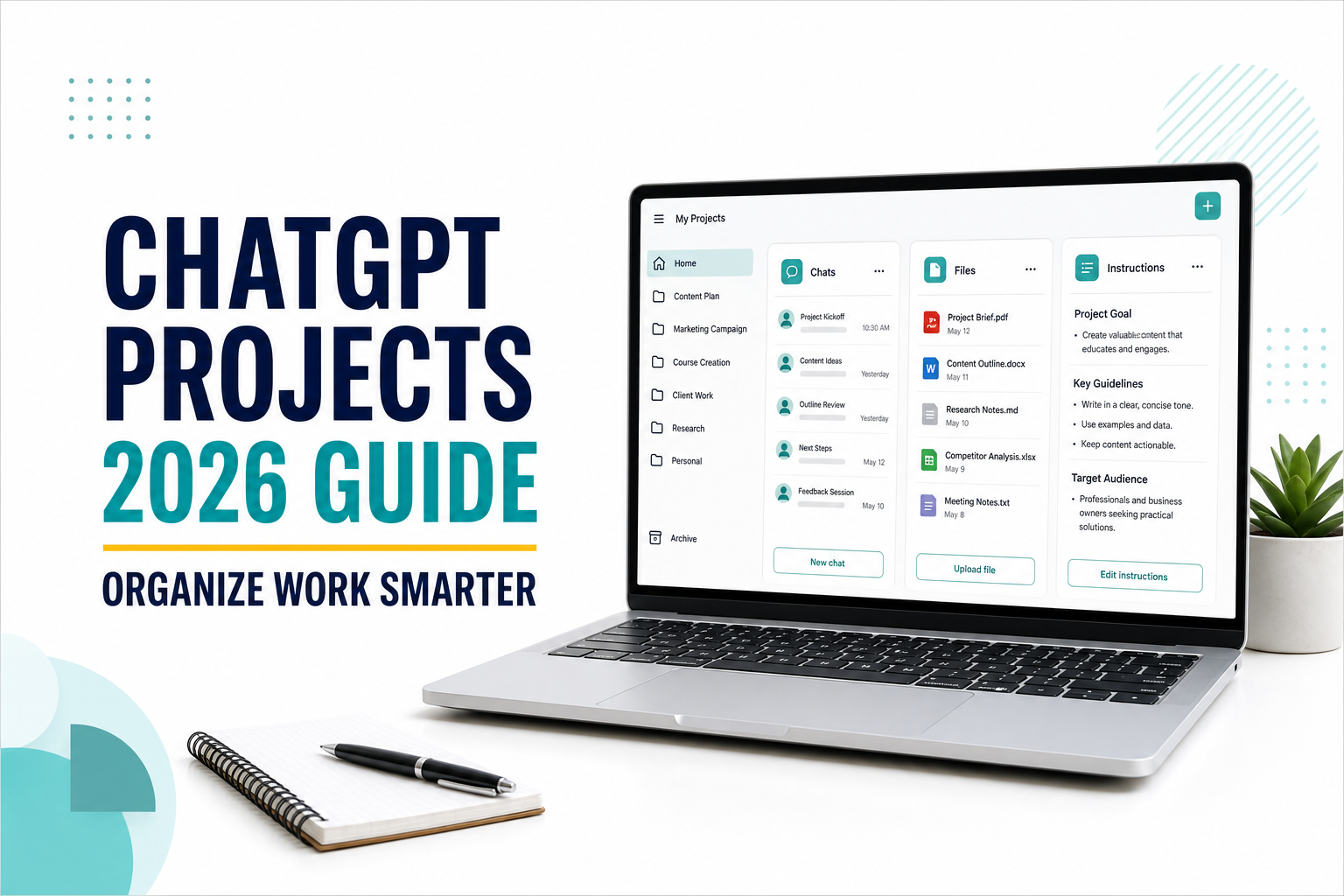
    How to Use ChatGPT Projects (2026 Guide)

    Starting a new ChatGPT conversation is easy. The harder part is keeping useful chats, reference files, instructions, and decisions organized when your work continues for days or weeks. ChatGPT Projects solves this problem by giving one ongoing task its own focused workspace.

    Instead of explaining the same background in every new chat, you can place related conversations and source material inside one project. ChatGPT can then work with the context that belongs to that project.

    In this guide, you will learn how to create a ChatGPT Project, add useful context, write project instructions, organize recurring work, and avoid common mistakes.

    Quick answer

    To use ChatGPT Projects, sign in to ChatGPT, select New project in the sidebar, name the project, and add the chats, files, and instructions needed for that work. Use a separate project for each long-running goal so its context stays focused.

    What Are ChatGPT Projects?

    ChatGPT Projects are dedicated workspaces for ongoing work. A project can keep related chats, uploaded files, project-specific instructions, and saved responses together. This makes it easier to return to a task without rebuilding the context from the beginning.

    OpenAI says Projects are available globally to signed-in users on free and paid ChatGPT plans. The tools and file limits available inside a project can still depend on your plan and workspace settings. You can confirm current details in the official OpenAI Projects guide.

    A project is especially useful when the work changes over time. Examples include a content calendar, job search, research report, course, marketing campaign, travel plan, or weekly business review.

    Regular chat vs. ChatGPT Project

    FeatureRegular chatChatGPT Project
    Best forOne question or a short taskOngoing, multi-step work
    ContextMainly the current conversationProject chats, files, and instructions
    OrganizationStored in the general chat listGrouped by one goal or subject
    InstructionsChat instructions or global preferencesInstructions written specifically for the project
    Returning laterYou may need to restate backgroundRelated context remains organized in one workspace

    How to Create a ChatGPT Project

    Step 1: Choose one clear goal

    Before creating a project, decide what belongs inside it. Avoid a name such as “Everything” or “General Work.” A focused name makes it easier to decide which chats and files should be included.

    • Good: 2026 Content Calendar
    • Good: Beginner Python Course
    • Too broad: Work and Personal Tasks

    Step 2: Select New project

    Sign in to ChatGPT and select New project in the sidebar. Enter a descriptive name. You may also be able to choose an icon and color, which helps when you manage several projects.

    Step 3: Choose the memory option carefully

    When creating a new project, ChatGPT may offer a choice between default memory and project-only memory. Project-only memory keeps the project self-contained: chats can reference other conversations in the same project but not conversations outside it.

    Choose project-only memory when you want a clear boundary between subjects, clients, courses, or sensitive work. OpenAI notes that project-only memory must be selected when the project is created; it cannot simply be added to an existing project later.

    Step 4: Add project instructions

    Open the project menu, select Project settings, and write instructions that apply only to this workspace. Project instructions can describe ChatGPT’s role, preferred tone, output format, audience, sources, or review process. They override your global custom instructions inside that project.

    Act as my content planning assistant.
    Write for beginners in clear English.
    Use short paragraphs, practical examples, and descriptive headings.
    Separate verified facts from suggestions.
    Before drafting, ask for the target keyword, reader, and goal.

    Step 5: Start the first chat

    Create a new conversation inside the project and explain the immediate task. Project instructions provide the working rules, while your first message should describe the specific result you need now.

    If you are new to the interface, begin with our guide on how to use ChatGPT for beginners.

    How to Add Useful Context

    Upload reference files

    You can add reference material such as PDFs, documents, spreadsheets, images, or pasted text. ChatGPT can use these sources when answering questions inside the project. Upload only material that is relevant to the project’s goal.

    File limits depend on your ChatGPT plan, and only a limited number of files can be uploaded at once. If a large source is unnecessary, upload the most relevant section instead.

    Move an existing chat

    If a useful conversation already exists, open its menu and choose Move to project, or drag it into the project when that option is available. After moving, the chat inherits the project’s instructions and file context.

    Some chats may not be eligible to move. For example, OpenAI says conversations created with a custom GPT cannot currently be moved into a project.

    Save a useful response as a source

    When ChatGPT creates a decision note, approved outline, summary, or reusable draft, open the response menu and save it to the project sources when that option appears. This gives later chats a stable reference instead of forcing you to search through old messages.

    7 Practical Ways to Use ChatGPT Projects

    1. Manage a content calendar

    Keep your audience notes, keyword plan, published URLs, outlines, and editorial instructions in one project. Use separate chats for topic research, drafting, editing, and internal linking while keeping the same overall context.

    2. Run a recurring work review

    Create a project for weekly plans, meeting notes, status updates, and decisions. Return each week to summarize progress and prepare the next action list. For more ideas, see our practical guide to using ChatGPT for work.

    3. Organize a research project

    Upload relevant papers, reports, interview notes, and source summaries. Ask ChatGPT to compare claims, identify unanswered questions, and maintain a running list of sources that still need verification.

    4. Plan a job search

    Store your resume, career goals, skill inventory, and job descriptions. Use different chats for company research, resume tailoring, interview practice, and follow-up messages without mixing the project with unrelated conversations.

    5. Build a personal learning hub

    Keep your course outline, notes, reading list, and practice questions together. You can also use ChatGPT Study Mode inside a project for guided explanations and active practice.

    6. Plan a trip or major purchase

    Collect requirements, options, budgets, booking details, and decision criteria. Ask ChatGPT to update comparisons when prices or priorities change, but verify current details with official providers before buying.

    7. Maintain a consistent writing workflow

    Add examples of your preferred style and project instructions for tone, structure, and audience. Then use separate chats for outlines, first drafts, editing, and quality checks. Strong instructions still matter, so review our guide on how to write better ChatGPT prompts.

    A Reusable Project Setup Formula

    A useful project usually needs six elements:

    1. Goal: The result the project should produce
    2. Audience: Who will use or read the result
    3. Sources: The files and facts ChatGPT should use
    4. Rules: Tone, format, constraints, and approval requirements
    5. Workflow: The stages used repeatedly
    6. Quality check: How important claims and final outputs are reviewed

    Reusable template:

    This project is for [goal].
    The main audience is [audience].
    Use the uploaded [sources] as primary context.
    Follow these rules: [tone, format, and constraints].
    Our workflow is [stages].
    Before finalizing any output, check [quality criteria].
    Ask a clarifying question when required information is missing.

    Using Tools Inside a Project

    Projects can use many of the same ChatGPT tools available in regular conversations. Depending on your account, you may be able to use web search, image generation, Canvas, voice, Study Mode, connected apps, deep research, or agent features.

    Tool availability depends on your subscription, device, workspace controls, and current usage limits. A project organizes context; it does not automatically unlock tools that are unavailable on your account.

    Common ChatGPT Project Mistakes

    Putting unrelated work in one project

    A project becomes less useful when it contains unrelated goals, audiences, and files. Create separate projects when the context or working rules are different.

    Uploading files without explaining their purpose

    Do not assume ChatGPT knows which file is authoritative or what each source should be used for. Explain the role of important files in your project instructions or first message.

    Writing vague project instructions

    “Help me with work” is too broad. State the goal, audience, preferred format, constraints, and when ChatGPT should ask questions.

    Treating project memory as perfect storage

    Important requirements should still be written clearly in project instructions or saved sources. Do not rely on ChatGPT to recall every detail exactly, especially when accuracy matters.

    Trusting every generated claim

    Projects improve organization, not factual certainty. Verify important medical, legal, financial, technical, and current information with reliable primary sources.

    Privacy and Important Limitations

    • Do not upload passwords, private keys, payment information, or material you are not allowed to share.
    • Check your organization’s rules before uploading client, employee, school, or company documents.
    • Plan limits can affect file uploads, tools, messages, and collaborators.
    • Deleting a project removes access to its chats, files, and instructions; save essential final work elsewhere.
    • Shared projects create additional visibility, so review files and chats before inviting other people.

    Use ChatGPT Custom Instructions for preferences that should influence regular chats, such as tone and response format. Use Projects for a specific ongoing workspace with its own files, context, and project-level instructions.

    Frequently Asked Questions

    Are ChatGPT Projects free?

    Yes. OpenAI says Projects are available globally on free and paid ChatGPT subscription types. File limits and advanced tools vary by plan.

    How many ChatGPT Projects can I create?

    OpenAI currently says users can create an unlimited number of projects. Limits still apply to files, tools, messages, and collaboration based on the account.

    Can I upload files to a ChatGPT Project?

    Yes. Projects can use files such as PDFs, documents, spreadsheets, and images. The number of files allowed depends on your plan.

    Can I move an old chat into a project?

    Often, yes. Use the chat menu or drag the chat into a project when the option is available. Some conversations, including chats created with a custom GPT, may not be eligible.

    Can I share a ChatGPT Project?

    OpenAI currently supports project sharing for ChatGPT users, but collaborator limits and workspace controls vary by plan. Review access permissions before sharing files or conversations.

    What is the difference between a Project and a custom GPT?

    A Project organizes ongoing work with related chats, files, and instructions. A custom GPT is a reusable customized assistant that can be designed for a particular behavior or task. Use a Project to manage evolving work and a custom GPT when you need a reusable assistant configuration.

    If a document or code draft inside your project needs repeated, targeted revisions, move the work into Canvas. Our ChatGPT Canvas guide explains how to edit selected sections, compare versions, review suggestions, and export the finished result.

    Final Thoughts

    ChatGPT Projects are most useful when your work needs continuity. They reduce repeated setup by keeping related chats, files, instructions, and saved outputs in one focused workspace.

    Projects are designed for task-specific continuity. If you want ChatGPT to reuse helpful personal preferences across otherwise separate conversations, compare this workflow with our ChatGPT Memory guide.

    Start with one project that has a clear goal. Add only relevant sources, write practical instructions, and separate different subjects when their context begins to conflict.

    A well-organized project will not replace careful thinking or fact-checking, but it can make repeated work easier to manage and more consistent over time.

  • How to Write Better ChatGPT Prompts (2026 Guide)

    How to Write Better ChatGPT Prompts (2026 Guide)

    Learning how to write better ChatGPT prompts is one of the most valuable skills you can develop when using AI.

    Many people believe ChatGPT gives poor answers, but in reality, the quality of the response depends heavily on the quality of the prompt.

    A clear and detailed prompt helps ChatGPT understand your goal, context, audience, and desired format, leading to more useful and accurate responses.

    In this guide, you’ll learn practical techniques for writing better ChatGPT prompts, along with examples you can use immediately.

    Whether you’re writing blog posts, emails, reports, or business documents, better prompts help ChatGPT generate more relevant and accurate responses.

    By understanding a few simple prompt-writing techniques, you can save time, reduce revisions, and get significantly better results from AI.

    Why Prompt Writing Matters

    A prompt is simply the instruction you give ChatGPT.

    The more information you provide, the better ChatGPT can understand what you’re trying to accomplish.

    Well-written prompts help ChatGPT:

    • Generate more accurate responses
    • Reduce misunderstandings
    • Save time
    • Improve writing quality
    • Produce more useful results

    If you’re new to ChatGPT, start with our beginner guide:

    How to Use ChatGPT for Beginners

    If you’re looking for ready-to-use examples, check out:

    Best ChatGPT Prompts for Work

    How to Write Better ChatGPT Prompts guide with prompt writing examples

    Writing better prompts is not about making them longer.

    It’s about providing the right information in a clear and structured way.

    The following practical tips will help you communicate more effectively with ChatGPT and consistently receive higher-quality responses.

    10 Tips for Writing Better ChatGPT Prompts

    The following techniques can dramatically improve the quality of ChatGPT’s responses.

    10 tips for writing better ChatGPT prompts infographic

    1. Be Specific

    Avoid:

    Write an email.

    Better:

    Write a professional email to a client explaining a one-week project delay.

    2. Provide Context

    Tell ChatGPT who you are, what you’re trying to accomplish, and who the audience is.

    The more context you provide, the better the response.

    3. Describe Your Goal

    Instead of asking for information, explain what you want to achieve.

    Example:

    Help me create a blog outline for beginners interested in AI.

    4. Specify the Format

    Ask for:

    • Bullet points
    • Table
    • Step-by-step guide
    • Checklist
    • Email
    • Blog post

    Example:

    Present the answer as a comparison table.

    5. Define the Tone

    Examples:

    • Professional
    • Friendly
    • Formal
    • Casual
    • Persuasive

    6. Mention the Audience

    Example:

    Explain artificial intelligence to a 12-year-old.

    7. Break Large Tasks into Smaller Steps

    Instead of asking ChatGPT to complete everything at once, divide the task.

    This usually produces higher-quality results.

    8. Ask Follow-up Questions

    Good prompting is often conversational.

    Ask ChatGPT to:

    • Expand
    • Simplify
    • Rewrite
    • Improve
    • Add examples

    Each follow-up prompt helps ChatGPT better understand your expectations and improve the final response.

    9. Review the Output

    Always check important information before using it.

    Verify facts related to:

    • Finance
    • Medicine
    • Law
    • Business

    Important decisions should always be based on verified information from trusted sources.

    10. Keep Improving Your Prompt

    Your first prompt doesn’t have to be perfect.

    Small improvements often produce dramatically better answers.

    A Practical Before-and-After Prompt Test

    Consider a common workplace task: telling a client that a project will be one week late. The two prompts below ask for the same deliverable, but they give ChatGPT very different amounts of useful information.

    Version 1: A vague request

    Write an email about a project delay.

    This request identifies the task, but not the recipient, reason, revised date, tone, or next step. ChatGPT has to make assumptions, so the draft may sound generic or include details that do not match the situation.

    Version 2: A structured request

    Write a concise email to an existing client explaining that the website redesign will be delivered on August 14 instead of August 7 because final accessibility testing needs more time.
    
    Acknowledge the inconvenience, take responsibility, and explain that the extra testing reduces the risk of problems after launch. Keep the tone calm and professional. Use a subject line, two short paragraphs, and a clear invitation to discuss any scheduling concerns. Do not invent discounts or additional project details.

    An illustrative result from the second prompt should be easier to use because the model no longer needs to guess the audience, facts, tone, structure, or prohibited details. The response can focus on communicating the delay instead of inventing the missing context.

    Why the second prompt is stronger

    • Task: Write a client email about a specific delay.
    • Context: The project, old date, new date, and reason are supplied.
    • Audience: The reader is an existing client.
    • Tone: Calm, professional, accountable, and concise.
    • Format: A subject line and two short paragraphs.
    • Boundary: The model is told not to invent compensation or project details.

    The lesson is not that every prompt must be long. It is that each instruction should remove an important ambiguity. If a detail will change whether the answer is usable, include it.

    Examples of Weak vs Strong Prompts

    Weak Prompt

    Write a blog post about AI.

    Better Prompt

    Write a 1,000-word beginner-friendly blog post about artificial intelligence.

    Use H2 and H3 headings, include practical examples, and keep the tone conversational.


    Weak Prompt

    Explain SEO.

    Better Prompt

    Explain SEO to a complete beginner using simple language.

    Include practical examples and a step-by-step guide.

    Common Prompt Formula

    A simple prompt structure is:

    Task

    Context

    Audience

    Format

    Tone

    Example:

    Write a 1,000-word blog post about AI productivity tools.
    
    Audience:
    Small business owners.
    
    Tone:
    Professional but easy to understand.
    
    Format:
    Use H2 and H3 headings with bullet points.

    Using a consistent prompt structure helps ChatGPT understand your request more accurately and produce better results.

    You can use this simple framework for almost any task, whether you’re writing emails, creating content, or planning projects.

    You can also use this framework in ChatGPT Study Mode to define your level, topic, goal, and preferred learning method before starting a guided study session.

    If you repeatedly ask for the same tone, response length, or formatting rules, save those preferences once with ChatGPT Custom Instructions and keep each task-specific prompt focused on the current goal.

    How to Diagnose a Weak ChatGPT Response

    When a response is disappointing, do not immediately rewrite the entire prompt. First identify the specific failure, then add the smallest instruction that addresses it.

    Problem in the responseLikely causePrompt improvement
    Too genericAudience, goal, or context is missingAdd who the answer is for and what decision or action it should support
    Too longNo length or priority was definedSet a word range and ask for only the most important points
    Wrong formatThe deliverable was not specifiedRequest a table, checklist, email, outline, or numbered steps
    Invented detailsThe model had to fill gapsSupply the facts and instruct it to label uncertainty instead of guessing
    Wrong toneThe relationship and tone were unclearDescribe the reader and use concrete tone words

    For an important factual task, add a verification instruction such as:

    Use only the information I provide and the sources you can verify. Separate confirmed facts from assumptions. If a claim cannot be verified, say so instead of guessing. Include links to the sources used.

    This instruction can reduce unsupported claims, but it does not guarantee accuracy. Review the sources yourself, especially for medical, legal, financial, safety, or other high-impact decisions. Our ChatGPT Search guide explains how to inspect citations and verify claims more carefully.

    OpenAI’s official prompt engineering best-practices guide likewise recommends clear, specific instructions, enough context, and iterative refinement after reviewing the first response.

    Common Mistakes to Avoid

    Avoid:

    • Being too vague
    • Missing context
    • Asking multiple questions at once
    • Forgetting the audience
    • Not reviewing the response

    Learn more:

    10 Common ChatGPT Prompt Mistakes

    If you’re new to ChatGPT, you may also enjoy:

    How to Use ChatGPT for Beginners

    Frequently Asked Questions

    Why are my ChatGPT answers too generic?

    Most generic responses happen because the prompt lacks enough detail or context.


    How long should a ChatGPT prompt be?

    There is no perfect length. A prompt should contain enough information for ChatGPT to understand your request.


    Can better prompts improve ChatGPT’s answers?

    Yes. Better prompts often lead to more accurate, detailed, and useful responses.


    Should I use ChatGPT or Google?

    ChatGPT is excellent for generating ideas, writing, and explaining concepts, while Google is better for finding recent information and official sources.

    Learn more:

    ChatGPT vs Google


    Can I reuse the same prompt?

    Yes.

    You can reuse prompts, but adjusting them to your audience, goals, and context usually produces better responses.

    Conclusion

    Better prompting is less about finding a secret phrase and more about reducing ambiguity. State the task, provide the context that affects the answer, identify the audience, define the output format, and set useful boundaries.

    Then review the response as a draft. If it is generic, inaccurate, too long, or poorly structured, diagnose that specific problem and refine one part of the prompt. This conversational approach is usually more effective than trying to write a perfect instruction on the first attempt.

    Clear prompts can improve relevance and reduce revisions, but they do not guarantee factual accuracy. Verify important claims with reliable primary sources and never treat a confident answer as proof.

    For repeated work, save the reusable structure and replace only the changing context. Over time, a small library of tested prompt templates can make ChatGPT more useful for writing, learning, planning, and everyday work.

  • Best ChatGPT Prompts for Work: 20 Practical Examples (2026 Guide)

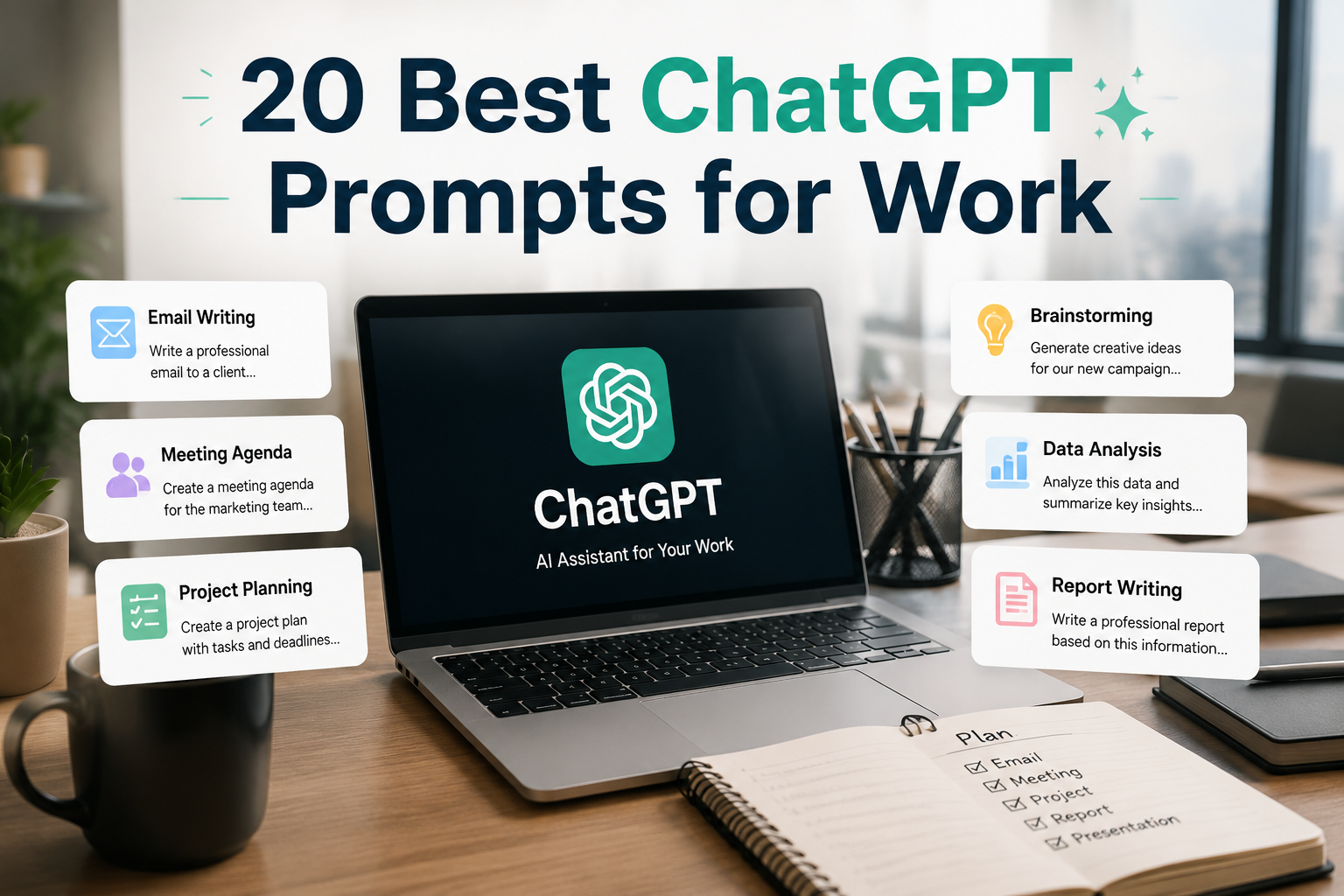
    Best ChatGPT Prompts for Work: 20 Practical Examples (2026 Guide)

    The best ChatGPT prompts for work can help professionals save time, improve productivity, and complete everyday business tasks more efficiently.

    Whether you’re writing emails, planning projects, or organizing meetings, using well-written prompts can significantly improve the quality of ChatGPT’s responses.

    However, the quality of ChatGPT’s responses depends largely on the prompts you provide. A well-written prompt can produce accurate, useful, and professional results, while a vague prompt often leads to generic answers.

    In this guide, you’ll discover 20 practical ChatGPT prompts for work that professionals can use for emails, meetings, project planning, research, marketing, presentations, customer communication, and more.

    Whether you’re an employee, freelancer, manager, or business owner, these prompts can help you work faster and more efficiently.

    Why Use ChatGPT Prompts at Work?

    Best ChatGPT prompts for work including email writing, project planning, meetings, research, and productivity.

    ChatGPT can support professionals in almost every industry by reducing repetitive work and helping generate ideas more efficiently.

    With the right prompts, you can:

    • Write professional emails
    • Plan projects
    • Organize meetings
    • Summarize documents
    • Brainstorm ideas
    • Create reports
    • Improve communication
    • Increase productivity

    If you’re new to ChatGPT, start with our beginner guide:

    How to Use ChatGPT for Work

    20 Best ChatGPT Prompts for Work

    20 professional ChatGPT prompts for work including email writing, meeting agendas, project planning, research, marketing, presentations, customer support, and reports.

    The following best ChatGPT prompts for work cover the most common professional tasks.

    1. Write Professional Emails

    Writing professional emails often takes more time than expected.

    ChatGPT can help you create clear, polite, and well-structured emails for clients, coworkers, and business partners.

    Example Prompt

    Write a professional email to a client explaining a one-week project delay.
    
    Keep the tone polite, positive, and solution-focused.

    You can also ask ChatGPT to make the email shorter, more formal, or friendlier depending on the situation.

    2. Create Meeting Agendas

    A clear meeting agenda keeps discussions focused and saves time.

    ChatGPT can quickly organize meeting topics and priorities.

    Example Prompt

    Create a one-hour meeting agenda for a weekly marketing team meeting.

    Include discussion topics, time allocations, and action items.

    3. Summarize Meeting Notes

    After meetings, organizing notes into clear summaries can be time-consuming.

    ChatGPT can identify the most important points and generate action items.

    Example Prompt

    Summarize these meeting notes into five key takeaways and create a list of action items.

    4. Plan Projects

    Managing projects becomes easier when tasks are organized into clear steps.

    ChatGPT can help build project timelines and task lists.

    Example Prompt

    Create a project plan for launching a new company website within six weeks.
    
    Include milestones, deadlines, and responsibilities.

    5. Organize Weekly Tasks

    Professionals often juggle multiple priorities.

    ChatGPT can organize tasks based on urgency and importance.

    Example Prompt

    Create a weekly work schedule based on these tasks.
    
    Prioritize urgent work while balancing meetings and focused work sessions.

    6. Brainstorm New Ideas

    Generating fresh ideas is easier when you have an AI brainstorming partner.

    ChatGPT can suggest multiple creative approaches to the same problem.

    Example Prompt

    Generate ten creative marketing ideas for a new coffee shop targeting young professionals.
    Include both online and offline marketing strategies.

    7. Research Topics Faster

    Research often involves reading multiple articles and comparing information.

    ChatGPT can summarize concepts and explain complicated topics in simple language.

    Example Prompt

    Explain blockchain technology for business professionals using simple language and practical examples.

    8. Analyze Business Data

    ChatGPT can help interpret reports and identify patterns within business data.

    Always verify important decisions using reliable data sources.

    Example Prompt

    Analyze this quarterly sales report and identify the three most important business insights.

    9. Write Professional Reports

    Reports should be clear, organized, and easy to understand.

    ChatGPT can improve clarity and structure.

    Example Prompt

    Rewrite this project report using a professional business tone.
    
    Organize the content into clear sections with headings.

    10. Create Presentation Outlines

    Instead of starting from a blank page, ChatGPT can quickly generate presentation structures.

    Example Prompt

    Create a 10-slide presentation outline about digital marketing trends in 2026.
    
    Include key talking points for each slide.

    11. Generate Marketing Ideas

    Marketing teams constantly need fresh campaign ideas and promotional strategies.

    ChatGPT can generate creative ideas based on your target audience, industry, and business goals.

    Example Prompt

    Generate 15 marketing campaign ideas for a cosmetic clinic targeting women in their 30s.
    
    Include social media, email, and offline marketing ideas.

    Providing your audience and business goals will produce much more relevant ideas.

    12. Reply to Customer Messages

    Responding to customer inquiries consistently can improve customer satisfaction.

    ChatGPT can help create professional and friendly responses for emails, live chat, and customer support.

    Example Prompt

    Write a polite reply to a customer requesting a refund.
    
    Show empathy, explain the company policy, and offer an alternative solution.

    13. Write Social Media Posts

    Creating engaging social media content every day can be challenging.

    ChatGPT can generate captions for Instagram, LinkedIn, Facebook, Threads, and X.

    Example Prompt

    Write five LinkedIn posts promoting AI productivity tools.
    
    Use a professional tone and include a question to encourage engagement.

    14. Create Blog Outlines

    Planning a blog becomes much easier when you have a clear structure before writing.

    ChatGPT can generate SEO-friendly outlines that organize your ideas logically.

    Example Prompt

    Create an SEO-friendly blog outline for the topic "Benefits of Artificial Intelligence for Small Businesses."
    
    Include H2 and H3 headings.

    15. Perform a SWOT Analysis

    A SWOT analysis helps evaluate strengths, weaknesses, opportunities, and threats.

    ChatGPT can quickly organize information into a clear business framework.

    Example Prompt

    Create a SWOT analysis for a small online clothing business entering a competitive market.

    16. Create Standard Operating Procedures (SOPs)

    Well-written SOPs help teams maintain consistency.

    ChatGPT can organize step-by-step workflows into professional documentation.

    Example Prompt

    Create a standard operating procedure for onboarding a new employee in a marketing department.

    17. Prioritize Daily Tasks

    Managing multiple deadlines becomes easier when tasks are properly prioritized.

    ChatGPT can organize work using urgency, importance, and estimated completion time.

    Example Prompt

    Prioritize these tasks using the Eisenhower Matrix and explain why.

    18. Translate Business Documents

    ChatGPT can translate documents while keeping a natural business tone.

    Always review important translations before sending them to clients.

    Example Prompt

    Translate this business proposal into professional English while maintaining a formal tone.

    19. Prepare Interview Questions

    Hiring managers can use ChatGPT to generate interview questions for different positions.

    Example Prompt

    Create ten behavioral interview questions for hiring a digital marketing specialist.

    20. Compare Business Decisions

    Sometimes choosing between multiple options can be difficult.

    ChatGPT can compare advantages and disadvantages objectively.

    Example Prompt

    Compare the advantages and disadvantages of outsourcing customer support versus hiring an in-house team.
    
    Present the answer as a comparison table.

    A Practical Workflow: Turn Messy Meeting Notes into an Action Plan

    Copying a prompt is only the first step. The useful part is giving ChatGPT enough context, reviewing the output, and correcting anything the model inferred without evidence.

    Consider a realistic situation: a project manager has rough notes from a 30-minute launch meeting. The notes contain decisions, possible deadlines, unanswered questions, and tasks whose owners are not yet confirmed. Instead of asking ChatGPT to “summarize this,” use a prompt that separates facts from assumptions.

    Reusable prompt

    I will paste rough notes from a project meeting.
    
    Create four sections:
    1. Confirmed decisions
    2. Action items in a table with task, owner, deadline, and status
    3. Open questions
    4. Risks or dependencies
    
    Use only information stated in the notes. If an owner or deadline is missing, write “Not confirmed” instead of guessing. After the table, list any statements that may need verification.
    
    Meeting notes:
    [Paste the notes here]

    How to Judge the Result

    A polished answer is not automatically a correct answer. Compare the response with the original notes and check four things:

    • Ownership: Did ChatGPT assign a task to someone who was only mentioned in the discussion?
    • Deadlines: Did it convert a tentative date into a confirmed commitment?
    • Missing context: Did the summary leave out a constraint, dependency, or objection?
    • Unsupported conclusions: Did it add a recommendation that was not present in the notes?

    If any item is uncertain, revise the prompt or correct the draft before sharing it. For longer assignments that use the same reference files and instructions repeatedly, our ChatGPT Projects guide explains how to keep that work in a focused workspace.

    Protect Sensitive Work Information

    Do not paste confidential client data, passwords, private financial records, employee information, or unpublished business plans into an AI tool unless your organization has approved that use. Replace names and identifying details with placeholders when possible, and follow your employer’s security and retention policies.

    If you want to revise a long draft section by section, see our ChatGPT Canvas guide for a more controlled editing workflow.

    Tips for Writing Better Work Prompts

    Give Clear Instructions

    The clearer your instructions, the better ChatGPT can understand your request.

    Avoid vague prompts and explain exactly what you want to achieve.

    For more prompt-writing tips, read our guide:

    10 Common ChatGPT Prompt Mistakes

    Provide Enough Context

    Include useful background information whenever possible.

    Helpful details include:

    • Your goal
    • Your audience
    • Your preferred format
    • The desired tone
    • Any important limitations

    For more ready-to-use examples, check out:

    Best ChatGPT Prompts for Beginners

    Keep Improving the Conversation

    Your first prompt doesn’t have to be perfect.

    Ask ChatGPT to rewrite, shorten, expand, simplify, or improve its previous response.

    The best results usually come from an ongoing conversation rather than a single request.

    Frequently Asked Questions

    Can ChatGPT improve productivity at work?

    Yes. ChatGPT can help professionals write documents, organize projects, summarize information, generate ideas, and automate repetitive tasks, allowing them to focus on higher-value work.

    Are these prompts suitable for beginners?

    These best ChatGPT prompts for work are suitable for employees, freelancers, business owners, and managers.

    Absolutely. Most of the prompts in this guide are simple enough for beginners to copy, modify, and use immediately.

    Can ChatGPT replace employees?

    No. ChatGPT is designed to assist people, not replace human judgment, creativity, communication, and decision-making.

    Should I verify ChatGPT’s answers?

    Yes. Always verify important information, especially when making financial, legal, medical, or business decisions.

    For more information about when to use ChatGPT or traditional search engines, read:

    ChatGPT vs Google

    Conclusion

    Best ChatGPT Prompts for Work can help professionals save time, improve productivity, and communicate more effectively.

    These best ChatGPT prompts for work can easily be customized for your own industry and daily workflow.

    Whether you’re writing emails, planning projects, brainstorming ideas, or creating presentations, using clear prompts will consistently produce better results.

    Start by trying a few of the prompts in this guide, customize them to fit your workflow, and continue refining your conversations with ChatGPT.

    The more you practice writing effective prompts, the more valuable ChatGPT will become in your daily work.

    ChatGPT is developed by OpenAI. To learn more about ChatGPT and its latest features, visit the official OpenAI website.

  • How to Use ChatGPT for Work: 10 Practical Examples

    How to Use ChatGPT for Work: 10 Practical Examples

    Many professionals are looking for ways to save time, improve productivity, and work more efficiently with AI.

    ChatGPT is an AI assistant developed by OpenAI that helps users write, research, organize information, and complete tasks more efficiently.

    How to Use ChatGPT for Work is becoming an important skill as more people use AI tools for writing, research, planning, and everyday business tasks.

    ChatGPT is not designed to replace human creativity or decision-making. Instead, it can help you complete repetitive tasks faster, organize your thoughts, and create better results.

    In this guide, you’ll learn 10 practical ways to use ChatGPT at work, including writing emails, summarizing information, creating content, planning projects, and improving productivity.

    How to Use ChatGPT for Work

    How to Use ChatGPT for Work

    ChatGPT can assist with many different workplace tasks.

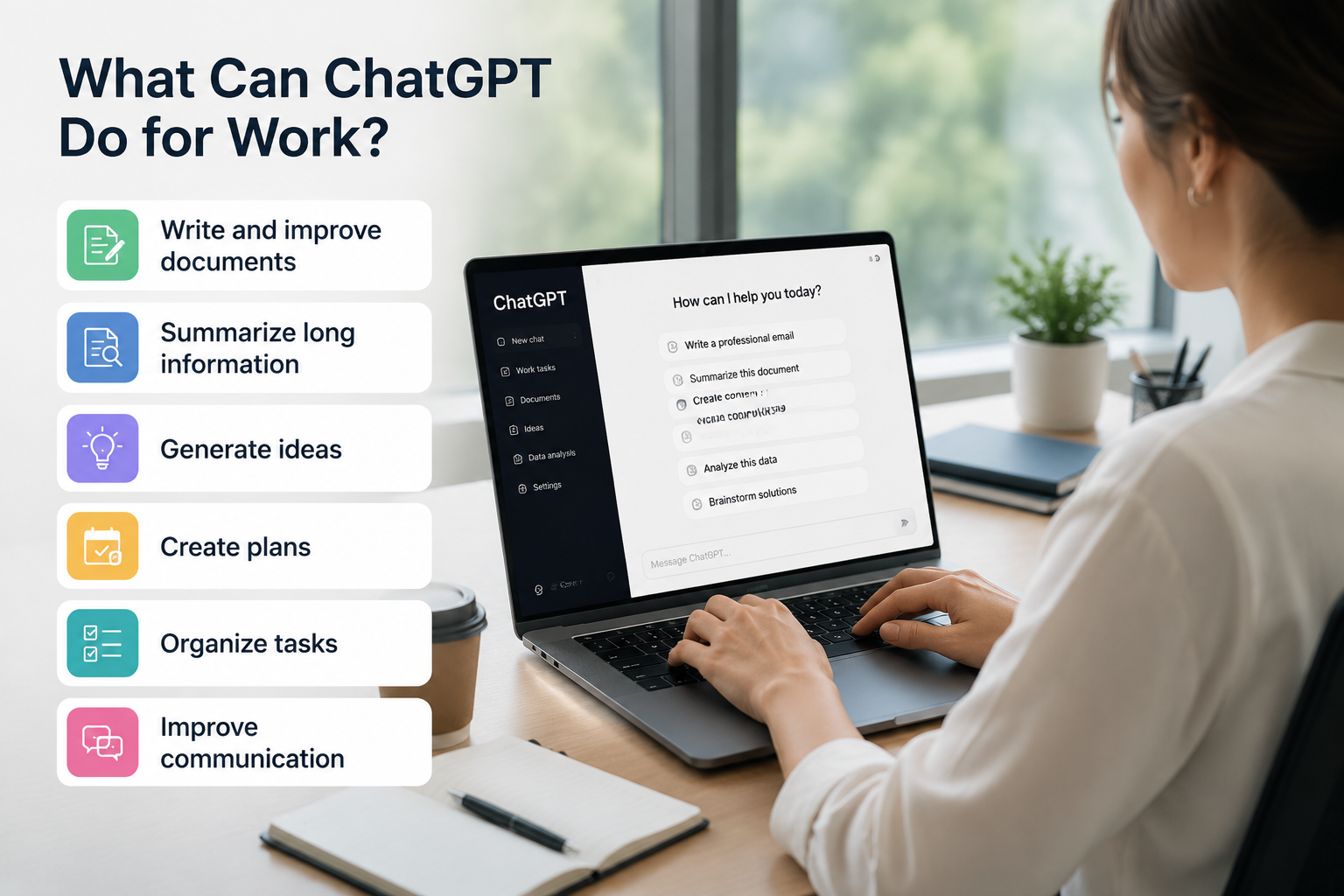
    Whether you are an employee, business owner, freelancer, or creator, ChatGPT can help you:

    • Write and improve documents
    • Summarize long information
    • Generate ideas
    • Create plans
    • Organize tasks
    • Improve communication

    If you are new to ChatGPT, start with our beginner guide: How to Use ChatGPT for Beginners.

    ChatGPT work use cases

    1. Writing Professional Emails

    Writing emails can take a lot of time, especially when you need the right tone and structure.

    ChatGPT can help you create professional emails, rewrite unclear messages, and adjust the tone depending on the situation.

    Example Prompt

    Write a professional email to a client explaining a project delay.
    Keep the tone polite and solution-focused.

    You can also ask ChatGPT to make an email shorter, friendlier, or more formal.

    2. Summarizing Long Documents

    Professionals often need to read reports, meeting notes, and research documents.

    ChatGPT can quickly summarize long content and highlight important information.

    Example Prompt

    Summarize this document into five key points.

    This can help you understand large amounts of information faster.

    3. Creating Content Ideas

    Content creation requires constant brainstorming.

    ChatGPT can help generate ideas for:

    • Blog posts
    • Social media content
    • Marketing campaigns
    • Video topics

    Example Prompt

    Create 10 content ideas for a small business.

    You can provide your industry, audience, and goals to get more relevant ideas.

    4. Creating To-Do Lists and Work Plans

    Managing multiple tasks can become difficult.

    ChatGPT can help organize your tasks into clear schedules and action plans.

    Example Prompt

    Create a weekly work schedule based on these tasks.

    You can also ask ChatGPT to prioritize tasks based on urgency and importance.

    5. Improving Writing Quality

    ChatGPT can help improve existing writing by making it clearer and more professional.

    It can help with:

    • Emails
    • Reports
    • Presentations
    • Articles
    • Business documents

    Example Prompt

    Rewrite this paragraph to sound more professional.

    Small improvements in wording can make your communication more effective.

    6. Research and Learning

    Learning new topics is an important part of many jobs.

    ChatGPT can explain complex topics in simple language and provide examples.

    Example Prompt

    Explain this topic like I'm a beginner.

    You can also ask ChatGPT to compare concepts, create summaries, or explain ideas step by step.

    7. Preparing Meetings

    Preparing for meetings often requires creating agendas, questions, and summaries.

    ChatGPT can help organize meetings more efficiently.

    Example Prompt

    Create a meeting agenda for a marketing team.

    You can also use ChatGPT to summarize previous meeting notes and create follow-up tasks.

    8. Creating Presentations

    Creating a presentation from scratch can take hours.

    ChatGPT can help you create:

    • Presentation outlines
    • Slide structures
    • Key talking points
    • Speaker notes

    Example Prompt

    Create a presentation outline about digital marketing.

    You can then customize the content based on your audience.

    9. Analyzing Data

    ChatGPT can help you understand data and find patterns.

    It can assist with:

    • Explaining data trends
    • Summarizing reports
    • Organizing information

    Example Prompt

    Analyze this data and explain the main insights.

    However, always verify important business decisions with accurate data sources.

    10. Brainstorming Solutions

    When facing a problem, generating multiple ideas can help you find better solutions.

    ChatGPT can act as a brainstorming partner by suggesting different approaches.

    Example Prompt

    Give me five possible solutions to this business problem.

    You can continue the conversation by asking ChatGPT to compare the advantages and disadvantages of each idea.

    A Practical Workflow: Turn Meeting Notes into Action Items

    A useful workplace test is to give ChatGPT a small set of meeting notes and ask for an action list that a team can actually review. The goal is not to let AI make decisions; it is to reduce the time spent organizing information.

    Example Prompt

    I will paste meeting notes below. Turn them into a table with four columns: action item, owner, deadline, and open question. Do not invent missing owners or dates; write “Not specified” instead. After the table, list any decision that still needs confirmation. Keep the wording concise.
    
    [Paste meeting notes here]

    How to interpret the result: a useful response separates confirmed tasks from unresolved questions. If ChatGPT assigns a person or deadline that does not appear in the notes, the output needs correction. This check is more important than how polished the table looks.

    Before sharing the result, compare every owner, date, number, and commitment with the original notes. Remove confidential client data, passwords, private employee information, and other sensitive material before entering workplace content into an AI tool.

    If you repeat the same type of task, you can store general preferences such as tone and formatting with ChatGPT Custom Instructions. Keep project-specific or confidential details out of permanent instructions.

    Best Practices for Using ChatGPT at Work

    Using ChatGPT effectively depends on how you communicate your instructions.

    Give Clear Instructions

    The better your prompt, the better your results will be.

    Avoid vague requests and provide enough context about your goal.

    Learn more about writing better prompts in our guide: 10 Common ChatGPT Prompt Mistakes

    Provide Enough Context

    ChatGPT works better when it understands your situation.

    Include details such as:

    • Your audience
    • Your goal
    • Your preferred format
    • Important background information

    For more prompt examples, check out our guide: Best ChatGPT Prompts for Beginners

    Review Important Information

    ChatGPT is a powerful assistant, but it can occasionally provide incorrect information.

    Always verify important information, especially for:

    • Business decisions
    • Financial information
    • Legal topics
    • Medical topics

    Learn more about choosing the right AI tool: ChatGPT vs Google

    Frequently Asked Questions

    Can ChatGPT improve productivity at work?

    Yes. ChatGPT can help reduce repetitive tasks, organize information, create drafts, and support better decision-making.

    Is ChatGPT useful for small businesses?

    Yes. Small business owners can use ChatGPT for marketing ideas, customer communication, content creation, and planning.

    Can ChatGPT replace employees?

    No. ChatGPT is a tool that helps people work more efficiently. Human judgment, creativity, and decision-making are still essential.

    Is ChatGPT safe to use at work?

    ChatGPT can be useful at work, but you should avoid entering confidential company information, passwords, or sensitive data.

    Conclusion

    Learning How to Use ChatGPT for Work can help professionals across many industries improve productivity and save time.

    By using ChatGPT for emails, research, writing, planning, and brainstorming, you can save time and focus on more important tasks.

    If you handle recurring work, learn how to use ChatGPT Projects to keep related chats, files, and instructions together in one focused workspace.

    When you are ready to move beyond general ideas, use our 20 practical ChatGPT prompts for work and follow the meeting-notes workflow to review owners, deadlines, and unsupported assumptions before sharing the result.

    The key is not simply using AI, but learning how to communicate with it effectively.

    Start with simple tasks, experiment with different prompts, and gradually discover how ChatGPT can improve your daily workflow.