Fictional scenario notice: This article uses a fictional clinic-marketing handoff to compare a vague and a controlled ChatGPT prompt. No real clinic, patient, customer, or employee data is involved.
Problem Breakdown & Direct Resolution
Writing better ChatGPT prompts starts with defining the outcome, separating confirmed facts from missing information, and stating when the model must stop. In this comparison, a vague request produced a usable draft, but a controlled prompt made the approval boundary, missing evidence, and publication status much clearer.
Both prompts were run using the same fictional clinic-marketing handoff scenario. The task was intentionally realistic: approved event copy and a desktop asset were available, while the closure date, mobile crop, customer-message send date, Google Business Profile hours, and tone reference were missing. No real clinic, patient, customer, or employee information was used.
Quick answer: Do not make a prompt longer just to make it look advanced. Add only the instructions that change the result: the goal, source facts, missing items, required output, approval boundary, and stop condition.
Step-by-Step Actionable Troubleshooting
Step 1: Use one controlled source note
I began with one short source note so that both runs received the same facts:
Please prepare next month’s website pop-up update. The event copy is approved, and desktop version 2 is ready. The closure date, mobile crop, customer-message send date, and Google Business Profile hours are still missing. Keep the same premium tone as last time.The note contains two confirmed inputs, four clearly missing operational details, and one ambiguous creative instruction. “Same premium tone as last time” sounds specific, but it is not verifiable unless a previous design, style guide, or approved reference is supplied. That ambiguity became an important part of the test.
Step 2: Run the vague prompt without helping the model
For Test A, the following short instruction was used:
Organize this fictional clinic marketing change request into a handoff note:

[source note]

Respond in English only.
The response was better than a simple “bad prompt versus good prompt” demonstration might suggest. ChatGPT created an objective, separated confirmed items from missing items, and proposed handoff actions. It did not invent the closure date, mobile crop, send date, or business hours.
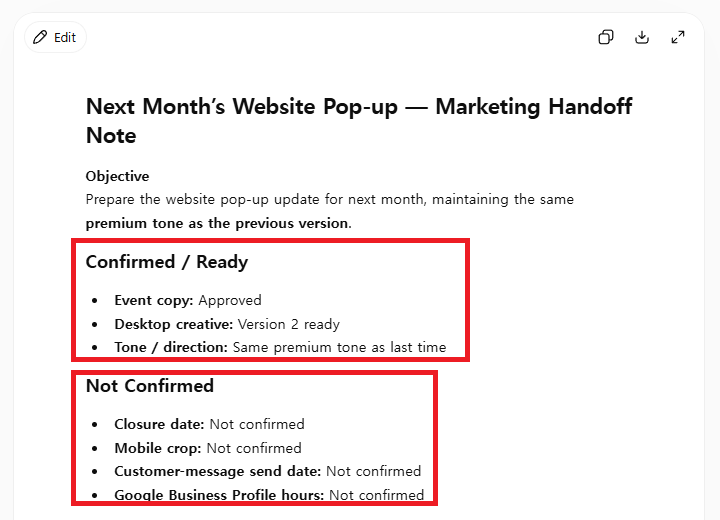
However, the result still depended on the model choosing a useful structure. It treated the requested premium tone as a direction even though no reference asset was available. It also did not create a dedicated approvals section or state a final publication decision. I could use the response as an early draft, but I would not use it as a final pre-publication handoff.
Step 3: Convert the weaknesses into requirements
Instead of adding random detail, I converted each observed weakness into one testable instruction. I required four named sections, an exact label for missing information, separate treatment of desktop and mobile assets, a ban on unsupported details, and a final stop condition.
- Outcome: produce a pre-publication handoff, not promotional copy.
- Evidence rule: use only facts in the supplied source note.
- Uncertainty rule: label every missing item “Not confirmed.”
- Asset rule: keep desktop and mobile work separate.
- Approval boundary: do not claim the pop-up is ready to publish.
- Stop condition: end with “Publication status: Not ready.”
This approach matches a useful principle in OpenAI’s current model guidance: define the expected outcome, success criteria, constraints, evidence rules, output shape, and stopping conditions. That page is written for API developers rather than as a guarantee for every ChatGPT interface, but the prompt-design principle translated well to this practical test.
Step 4: Run the controlled prompt in a new chat
I opened a new regular ChatGPT conversation and used the same source note with the controlled requirements. Starting a new chat reduced the chance that the first response would influence the second result.
Turn the source note into a pre-publication handoff using exactly these four sections:

1. Confirmed inputs
2. Not confirmed
3. Required approvals
4. Next actions

Use only the facts in the source note. Label every missing item exactly “Not confirmed.” Treat the unsupplied tone reference as not confirmed. Keep desktop and mobile assets separate. Do not invent dates, names, prices, medical claims, assets, or approvals. Do not state that the pop-up is ready to publish. End with: “Publication status: Not ready.”
The controlled response preserved the two confirmed facts, moved all unresolved details into “Not confirmed,” created an approvals section, and ended with the required publication status. Most importantly, it recognized that “same premium tone as last time” was not a confirmed specification without a reference.
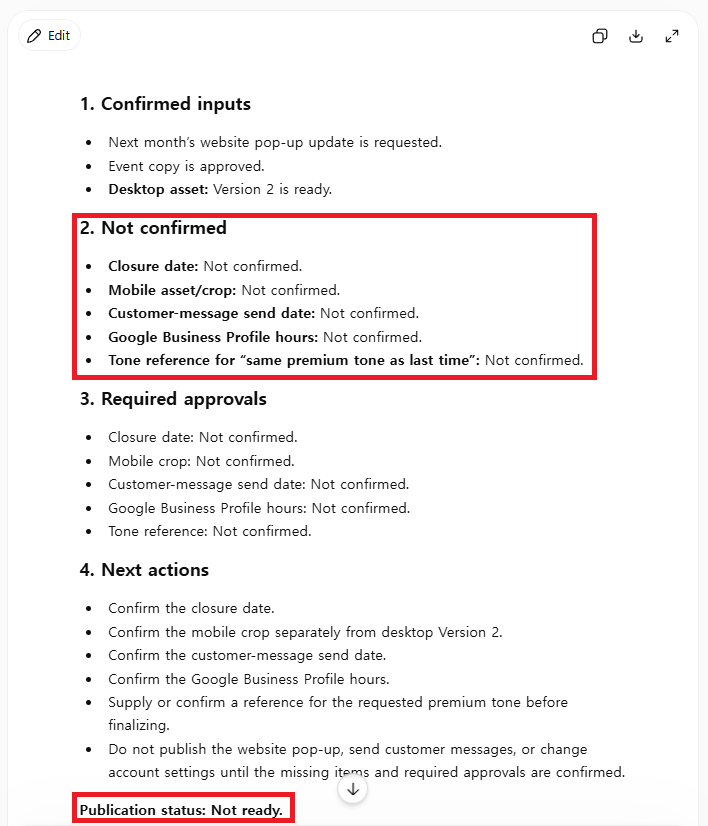
The controlled version was not valuable because it was longer. It was valuable because I could audit it against the source note. Every important output had a visible reason for being confirmed, unresolved, or blocked.
Step 5: Review the answer instead of trusting its tone
A polished answer can still be operationally unsafe. Both outputs can be reviewed line by line against the source note, using four questions:
- Did the response add any date, asset, approval, or claim that was not supplied?
- Did it turn an ambiguous preference into a confirmed requirement?
- Could a teammate distinguish desktop work from mobile work?
- Did the answer clearly stop before publication or account changes?
This review matters in my marketing workflow because the most expensive errors are often small: a closure date is assumed, a mobile crop is forgotten, or an approved desktop version is mistaken for complete campaign approval. ChatGPT can organize the handoff, but the human owner must verify the real date, copy, image, link, and publishing authority.
Real-World Pitfalls & Pro Tips
A common mistake to avoid is asking for “a professional result” without defining what professional means. In this test, “premium tone” could refer to typography, spacing, photography, color, or writing style. If the reference is unavailable, the correct output is not a confident guess; it is a visible blocker.
For a focused checklist of recurring failures to catch before a handoff, see this article on common ChatGPT prompt mistakes in design work.
- Do not confuse length with control. A shorter prompt can work when the task is low risk. Add constraints only when they change behavior.
- Use exact labels for operational gaps. One phrase such as “Not confirmed” is easier to scan than several vague alternatives.
- Separate source facts from creative language. Approved dates and assets are evidence; tone suggestions are not evidence unless a reference exists.
- Name the prohibited side effects. For a draft, state that nothing should be published, sent, or changed automatically.
- Test in a fresh chat. A new conversation makes an A/B comparison easier to interpret because less prior context can leak into the result.
- Save the original source note. Without it, you cannot prove whether a result preserved facts or invented them.
Specification / Comparison Checklist
| Audit criterion | Vague prompt | Controlled prompt |
|---|---|---|
| Supplied facts preserved | Pass | Pass |
| Missing inputs visible | Pass | Pass |
| Tone reference challenged | Partial | Pass |
| Desktop/mobile separated | Partial | Pass |
| Approvals separated | Partial | Pass |
| Publication stop stated | Not explicit | Pass |
The vague prompt was not a failure. It produced a respectable early draft and preserved the obvious missing facts. The controlled prompt was better for a handoff that could affect a live website because it reduced interpretation and made the stop condition auditable.
A Reusable Template for Better ChatGPT Prompts
Goal:
[Describe the decision-ready output you need.]

Confirmed inputs:
[List only verified facts and approved assets.]

Not confirmed:
[List missing dates, owners, links, assets, or approvals.]

Success criteria:
[State what the response must make clear.]

Constraints:
- Do not invent missing information.
- Keep desktop and mobile requirements separate.
- Label unresolved items “Not confirmed.”
- Do not publish, send, or change account settings.

Output:
[Name the required sections and preferred length.]

Stop condition:
[State the status the model should return when evidence is incomplete.]
I would shorten or expand this template according to the risk of the task. A brainstorming request may need only a goal and audience. A handoff involving dates, customer messaging, public pages, or business listings needs evidence rules, approvals, and a clear stopping point.
If you want beginner-friendly practice before adapting this framework to a live workflow, use these ChatGPT prompt templates for beginners.
Frequently Asked Questions
Does a longer prompt always produce a better answer?
No. In this scenario, the vague prompt already handled several facts correctly. The controlled prompt improved the result because its added instructions addressed observed weaknesses, not because it contained more words.
Should I tell ChatGPT every step to follow?
Only when the exact process matters. For many tasks, it is better to define the outcome, evidence, constraints, success criteria, and stop condition. Specify steps when they are required for safety, compliance, evaluation, or a repeatable workflow.
How do I prevent ChatGPT from guessing missing business details?
List the available evidence, require an exact uncertainty label, prohibit unsupported dates and approvals, and define what happens when information is missing. Then compare the answer with the original source note before anyone publishes or sends it.
Final Takeaway
The most useful improvement was not adding a role such as “You are an expert.” It was turning an informal request into an auditable contract: use these facts, expose these gaps, follow this output shape, and stop before an unsupported action.
If you are new to ChatGPT, start with this 10-minute beginner field test. For recurring work that needs persistent files and instructions, read the ChatGPT Projects guide. In every case, treat the output as a draft that still needs human verification.