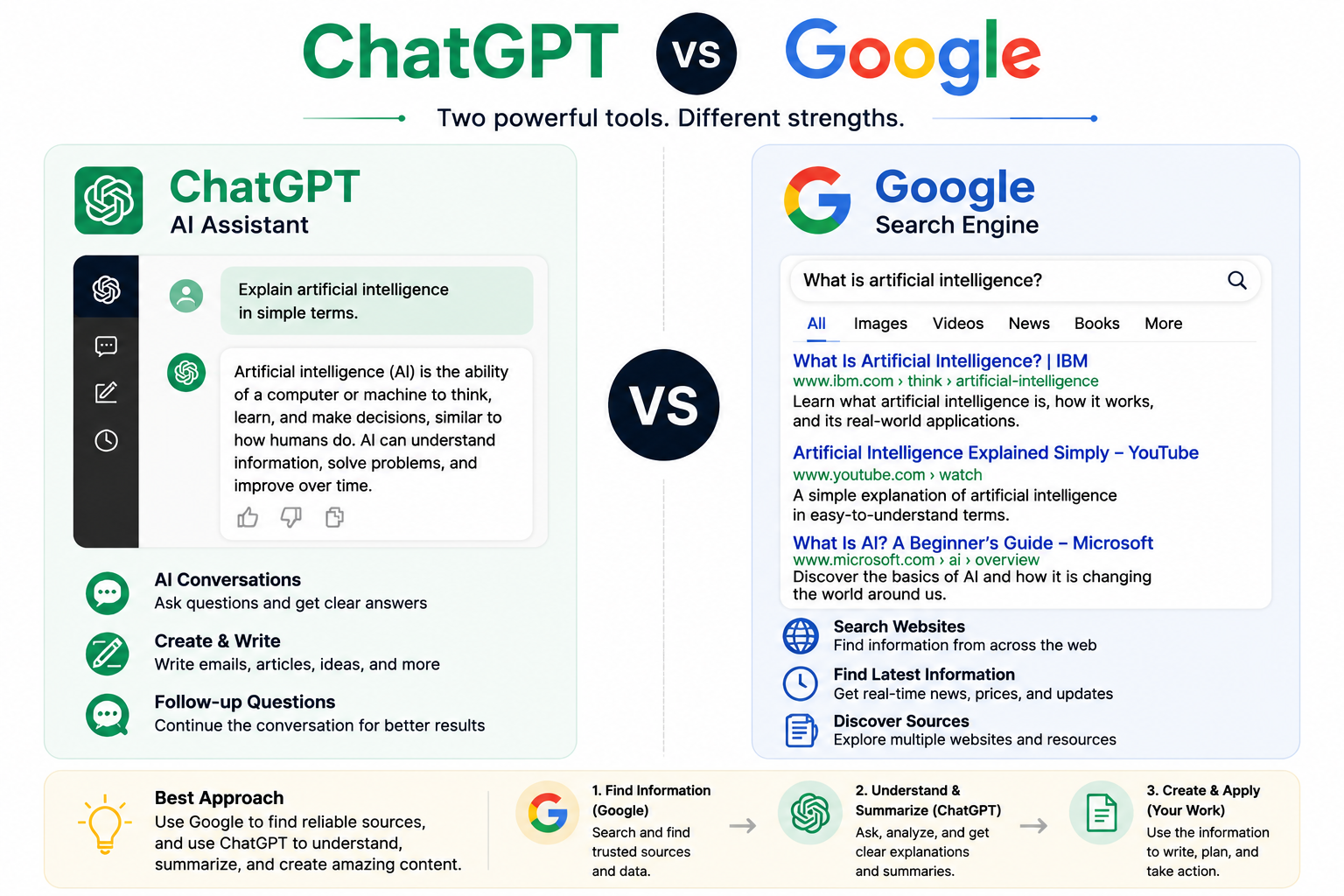
ChatGPT vs Google is no longer a simple “AI versus search engine” comparison. In my hands-on tests, ChatGPT was most useful for turning a vague question into a structured verification plan, while Google Search was most useful for locating the current primary source that could support—or overturn—the draft answer.
I tested that workflow with two questions that could cause real mistakes if handled casually: a lithium-battery travel rule and an AdSense ads.txt requirement. The first affected a safety and travel decision. The second affected a publishing decision on BJ Creates. In both cases, a polished summary was not enough; I needed to know which statement was confirmed, which source controlled the decision, and what still required human judgment.
This guide documents the method and its observed limits. It does not claim that either tool is always superior, and it does not treat a single test run as proof of universal behavior.
Problem Breakdown & Direct Resolution
Use ChatGPT to frame, explain, and compare a claim; use Google Search to find and inspect the controlling primary source. For any rule, deadline, policy, safety limit, or account decision, I do not act until the important statement is confirmed on the original page.
Direct answer: ChatGPT is the better working surface when I need an organized explanation, follow-up questions, or a draft. Google Search is the better discovery surface when I need the latest official rule, several independent perspectives, a local result, or the original publisher. ChatGPT Search can also retrieve current sources, but I still open the cited page before relying on it.
The practical problem is not choosing one winner. It is preventing a fluent answer, an outdated search snippet, or a secondary article from becoming the final authority. OpenAI’s current accuracy and limitations guidance says ChatGPT can produce incorrect or misleading information and recommends verifying important claims with reliable sources. That is the rule I applied to both field tests.
Step-by-Step Actionable Troubleshooting
Step 1: Classify the Question Before Choosing a Tool
I first ask what kind of error would matter. A brainstorming error may waste a few minutes. A travel-safety error, legal interpretation, medical claim, account-policy statement, price, deadline, or operating-hour mistake can produce a real cost. When the consequence is meaningful or the information can change, I treat the answer as a verification task rather than a writing task.
- Define the exact claim. I rewrite a broad question as one statement that can be checked.
- Identify the authority. I decide whether the controlling source should be a government agency, product provider, airline, platform, or account dashboard.
- Set a stop condition. If the current primary source is unavailable or ambiguous, I label the result “Not confirmed” instead of filling the gap.
Step 2: Field Test One—Lithium-Battery Travel Rules
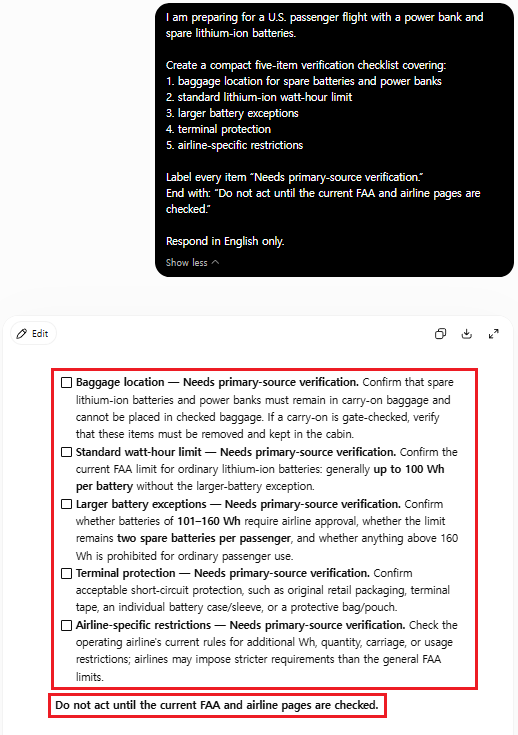
For the first test, I used ChatGPT as an orientation tool. I wanted a structured list of the details that mattered before checking a U.S. government source. My test prompt was:
I am preparing for a U.S. passenger flight with a power bank and spare lithium-ion batteries. Organize the questions I must verify, including baggage location, watt-hour limits, quantity limits, terminal protection, and airline-specific restrictions. Do not present the result as final authority. End with the primary sources I should open before travel.The useful part of the response was the structure: it separated spare batteries from batteries installed in devices and surfaced watt-hours, quantity, protection, and carrier rules as separate checks. The risky part was that a well-organized answer could still be outdated, apply to the wrong country, or omit a stricter airline rule. I therefore treated every number as provisional.
Google Search can be used to locate the FAA’s PackSafe lithium-battery page, and the result should be opened rather than relied on through the search snippet alone. The FAA page states that spare lithium batteries, including power banks and portable chargers, must be carried on and cannot be checked, that rechargeable lithium-ion batteries rated 0–100 Wh are allowed while batteries rated 101–160 Wh require airline approval and batteries over 160 Wh are forbidden on passenger aircraft, and that spare batteries must be protected from damage and short circuit. Airlines may impose stricter limits.
My decision was not “ChatGPT was wrong” or “Google was right.” ChatGPT helped me discover the verification fields; the FAA page supplied the controlling U.S. rule; and the airline remained a second required check. If the trip involved another jurisdiction, the FAA would not automatically be the correct authority.
Step 3: Field Test Two—Is ads.txt Required for AdSense Approval?
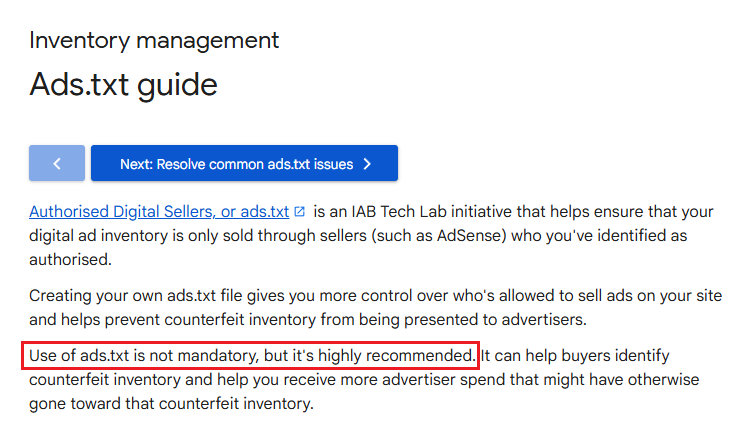
The decision rule below reflects how a Google ads.txt policy page can be checked before drawing a mandatory-versus-recommended conclusion.The second test came from a real publishing problem on BJ Creates. An AdSense dashboard status can make a recommended configuration look like an approval requirement. I needed to separate two claims: whether ads.txt is mandatory and whether implementing it is still a sensible operational step.
Separate these two questions: (1) Is ads.txt mandatory for AdSense site approval? (2) Is ads.txt still recommended after approval? Do not infer policy from dashboard wording. Tell me which current Google Help page I must verify and label anything unsupported as Not confirmed.ChatGPT can be useful for decomposing the question, but its wording should not be treated as policy. The applicable official ads.txt guide should instead be checked directly, alongside the site’s own live ads.txt status, before drawing any conclusion about whether ads.txt is required or recommended, where the file should be published, or how quickly a status change might appear.
The operational decision became clear: I should maintain a correct ads.txt file, but I should not describe it as a guaranteed approval requirement or mistake an authorized status for proof that the site’s content quality has passed review. That distinction mattered because BJ Creates had previously received a low-value-content decision; changing ads.txt alone could not solve an editorial-quality problem.
Step 4: Record the Evidence and the Remaining Human Decision
After each check, it helps to record the claim, source owner, page date or check date, verified wording, unresolved exception, and next action, along with the direct URL rather than only a screenshot, because the page may change. For recurring research, the ChatGPT Projects field test shows one way to keep confirmed source material separate from missing inputs.
- Confirmed: a statement supported by the current primary source I opened.
- Not confirmed: a claim that lacks the required source, date, jurisdiction, or account evidence.
- Human decision: the action that still belongs to the traveler, publisher, administrator, or other accountable owner.
Real-World Pitfalls & Pro Tips
A common mistake to avoid is treating citations as automatic proof. A cited page can be secondary, outdated, outside the relevant jurisdiction, or unrelated to the exact claim. I open the source, find the supporting sentence, check the page owner and update date, and read the nearby exceptions.
- Do not trust confidence. Clear prose and confident tone are presentation qualities, not evidence.
- Do not trust the snippet alone. Search snippets can omit qualifiers, dates, and exceptions.
- Do not confuse discovery with authority. Google can find a useful page, but the page owner and content determine whether it controls the decision.
- Do not mix jurisdictions. A U.S. FAA rule does not automatically answer a question governed by another country.
- Do not freeze a policy in time. I include a checked date and revisit the source before a consequential action.
- Use AI for the audit trail. I ask it to list missing evidence and conflicting statements, not to invent certainty.
If I need current web research inside a conversation, I can use ChatGPT Search, but I apply the same source audit. The ChatGPT Search citation audit explains how I inspect citations instead of counting them. When I need several perspectives, local information, images, maps, or a broad survey of the open web, Google Search remains a strong discovery tool.
Specification / Comparison Checklist
| Research need | Best first step | Release condition |
|---|---|---|
| Explain or decompose a question | Ask ChatGPT for claims, unknowns, and source types | Do not treat the draft as authority |
| Find a current official rule | Use Google Search or ChatGPT Search to locate the owner | Open and read the primary page |
| Compare several viewpoints | Search broadly, then group sources by role | Keep fact, opinion, and inference separate |
| Make a safety or policy decision | Identify jurisdiction, date, and accountable owner | Verify exceptions before acting |
| Continue research over time | Save sources, checked dates, and unresolved items | Recheck when the rule or dashboard changes |
Google’s official ranking systems overview explains that Search considers signals such as query meaning, relevance, source expertise, usability, location, and settings. That does not mean the first result is automatically the correct authority. It means I still need to evaluate the source that the ranking system surfaced.
FAQ Section
Is ChatGPT or Google better for current airline battery rules?
I use ChatGPT to organize the questions, then verify the rule on the relevant aviation authority and airline pages. For a U.S. passenger flight, the FAA page is a primary source, but the carrier may set stricter limits and another country may have a different authority.
Can a ChatGPT answer with citations replace opening the sources?
No. Citations improve traceability, but I still open the page, locate the supporting statement, check the owner and date, and read exceptions. A citation count is not a quality score.
Does an authorized ads.txt status guarantee AdSense approval?
No single status guarantees approval. Check Google’s current Help page for ads.txt directly, and separately verify the site’s live ads.txt status, before relying on any mandatory-versus-recommended description. A correct file supports inventory authorization, but it does not replace content-quality, policy, navigation, ownership, or site-readiness review.
Final Workflow Verdict
Both workflows point to the same decision. ChatGPT is valuable before and after source discovery: it can frame the question, separate claims, summarize differences, and help preserve an audit trail. Google Search is valuable for reaching the current primary page and exploring the wider web. Neither tool removes the need for human verification.
The durable skill is not memorizing which platform “wins.” It is knowing when a response is only a draft, when a search result is only a lead, which source owns the rule, and what must remain “Not confirmed” until a person checks it.