Category: AI

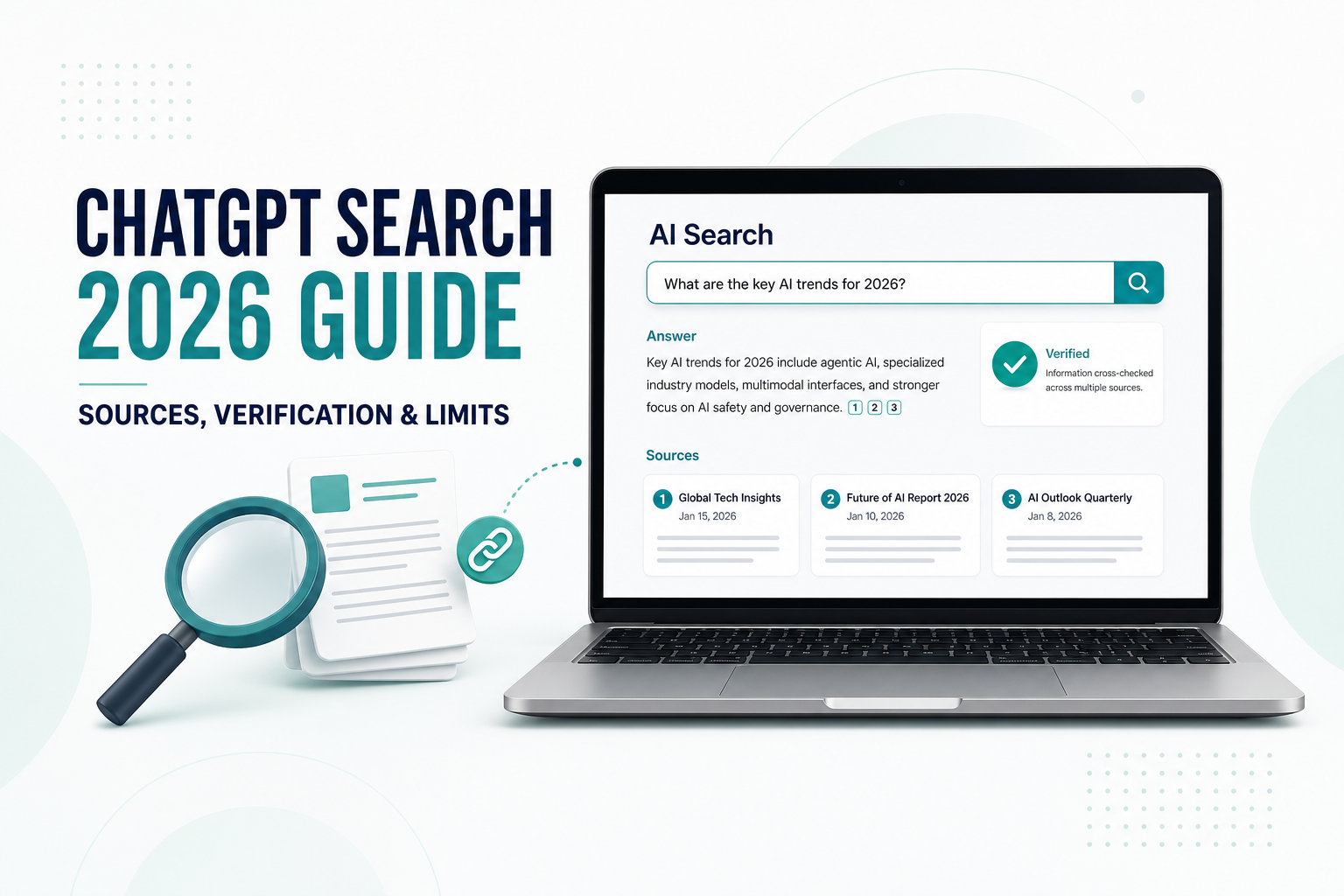
  • How to Use ChatGPT Search (2026 Guide): Sources, Verification & Limits

    How to Use ChatGPT Search (2026 Guide): Sources, Verification & Limits

    ChatGPT Search can turn a broad question into a timely answer with links to web sources. That makes it useful for travel planning, product research, local recommendations, and work that depends on current information.

    However, a cited answer is not automatically a correct answer. A source may be outdated, a page may not support the exact claim, or an important detail may be missing. The most reliable way to use ChatGPT Search is to treat it as a research assistant: ask a focused question, inspect the citations, and verify the details that affect your decision.

    Quick answer

    Open ChatGPT, choose Search from the tools menu—or simply ask a question that needs current web information. After the answer appears, open the inline citations or the Sources panel. Check that each important claim is supported by a relevant, current, trustworthy page before acting on it.

    What Is ChatGPT Search?

    ChatGPT Search is a web-search feature inside ChatGPT. It can find recent information, combine material from multiple pages, and present an answer with links to relevant sources. According to OpenAI, Search is available on ChatGPT’s web, desktop, and mobile experiences, and ChatGPT may search automatically when a question would benefit from web information.

    You can also select Search manually. In the current interface, open the tools or sources menu near the message box and choose Search. Typing / may also show Search as an option. Interface labels can change, so use the tools menu if a shortcut is not visible.

    The important difference is not simply that Search can access the web. It is that a search response can include inline citations and a Sources panel, giving you a path from the summary back to the original pages.

    ChatGPT Search vs. a Regular Chat

    FeatureRegular ChatGPT responseChatGPT Search response
    Best forExplanation, drafting, brainstorming, and stable knowledgeCurrent events, changing details, local information, and web research
    Web sourcesMay not use the web for the answerUses web search when activated or considered useful
    CitationsNot always presentMay include inline citations and a Sources panel
    FreshnessCan rely on learned informationCan retrieve more recent pages, subject to availability
    Your responsibilityCheck important factsOpen and evaluate the cited sources

    If you want a broader comparison of search engines and AI answers, read our guide to ChatGPT vs. Google.

    How to Use ChatGPT Search Step by Step

    Step 1: Decide whether the question needs the web

    Use Search when the answer can change with time or location. Examples include opening hours, prices, product availability, recent software changes, schedules, regulations, and news. A timeless task such as rewriting an email usually does not need web search.

    Step 2: Add the details that control the answer

    A vague request creates vague research. Include the place, date, budget, preferred source type, and the decision you are trying to make. If freshness matters, ask ChatGPT to state when each source was published or last updated.

    Weak search prompt:

    Find a good coworking space.

    Stronger search prompt:

    I need a coworking day pass near Toronto Union Station for this Sunday.
    
    Requirements:
    - Within a 15-minute walk
    - No more than C$40 before tax
    - Open from at least 10 a.m. to 4 p.m.
    - Reliable Wi-Fi and a quiet work area
    
    Search the web and give me three options in a table. For every price and opening-hour claim, cite the business's official website. State when the page was accessed, and mark any detail that you could not verify.

    Step 3: Open the citations

    On desktop, you may be able to hover over an inline citation and click it. If citations are not visible in the text, select Sources below the response to open the source panel. Do not judge a source only by its title. Open the page and find the sentence, table, policy, or listing that supports the claim.

    Step 4: Verify the decision-critical details

    In the coworking example, the decision-critical details are the Sunday hours, day-pass price, exact location, and whether a day pass is actually available without a membership. A blog post that mentions the space is weaker evidence than the company’s current booking or location page.

    Step 5: Ask a follow-up that exposes uncertainty

    Review your answer as a skeptical fact-checker.
    
    List:
    1. Claims supported by an official primary source
    2. Claims supported only by a third-party source
    3. Claims that may be outdated or ambiguous
    4. Details I should confirm directly before visiting
    
    Do not add new claims unless you cite them.

    A Practical Source-Checking Method

    A long source list can create a false sense of certainty. Use this five-part check for the claims that matter most.

    1. Relevance: Does the page support the exact claim, or only discuss a related topic?
    2. Authority: Is it an official organization, original research, a regulator, or the business responsible for the information?
    3. Freshness: Is there a publication or update date, and is it recent enough for the question?
    4. Agreement: Do other credible sources support the same conclusion?
    5. Scope: Does the information apply to your country, plan, product version, date, or situation?

    Useful rule: The higher the cost of being wrong, the closer you should get to the primary source.

    What to Do When Sources Disagree

    Conflicting sources are common. One page may be old, one may describe a different region, and another may repeat information without checking it. Do not ask ChatGPT to choose a winner without explaining why.

    These two sources disagree about [specific claim].
    
    Compare them by:
    - Publication or update date
    - Whether each is a primary or secondary source
    - Geographic and product scope
    - Evidence provided
    
    Explain the most likely reason for the disagreement. If the conflict cannot be resolved, say so clearly and tell me what I should verify directly.

    When the subject is legal, medical, financial, or safety-related, use Search to locate authoritative material—not to replace a qualified professional or an official source. For a medical decision, for example, a cited summary is still not a diagnosis.

    5 Useful ChatGPT Search Prompts

    1. Check a recent software change

    Search for the latest official information about [feature].
    Use the product's official documentation and release notes first.
    Tell me the supported plans, platforms, and rollout limitations.
    Separate confirmed facts from reasonable inferences.

    2. Build a source-first briefing

    Create a 250-word briefing on [topic] using sources published or updated within the last 90 days.
    Prioritize primary sources and reputable reporting.
    Place a citation immediately after every time-sensitive claim.
    End with three unresolved questions.

    3. Verify a number

    Find the original source for this statistic: "[paste claim]."
    Do not cite a page that merely repeats it.
    Report the original publication date, methodology, sample or scope, and any limitations.

    4. Compare current options

    Compare [option A] and [option B] for [specific use case] as of today.
    Use official pricing and feature pages where possible.
    Show price, major limits, cancellation terms, and the date each source was checked.
    Mark information that varies by region or plan.

    5. Audit an answer before sharing it

    Audit the answer above before I share it.
    Create a table with columns for Claim, Citation, Source Type, Date, Direct Support, and Risk.
    Label any unsupported or weakly supported claim and rewrite it more cautiously.

    If your prompts still produce vague results, review these common ChatGPT prompt mistakes.

    Privacy and Location Considerations

    Search prompts can be rewritten into more targeted queries and sent to third-party search providers. OpenAI says it may use general location inferred from your IP address to improve local results, but it does not send your IP address or ChatGPT account information to those search providers for the search.

    Precise device location is optional. If you enable it, local results may become more relevant. OpenAI’s current help page says precise location is used for the response and then deleted, although location-related details that appear in the answer can remain in your chat history.

    Avoid placing confidential client data, private documents, account credentials, or unnecessary personal details in a search prompt. Replace sensitive names and identifiers with neutral labels whenever possible. If you regularly handle private material, review your organization’s policy and ChatGPT data controls before using web search.

    Limits of ChatGPT Search

    • A citation can be weak: The linked page may be related without directly proving the sentence.
    • Pages can be outdated: A result may rank well even after a price, policy, or feature changes.
    • Coverage is incomplete: Paywalls, technical restrictions, site preferences, or missing indexed pages can limit what Search can access.
    • Summaries can remove nuance: Conditions, exceptions, and regional differences may disappear in a short answer.
    • Confident wording is not proof: ChatGPT can still produce an incorrect or misleading conclusion.
    • Usage limits apply: Search availability and limits can depend on the current ChatGPT plan and product experience.

    OpenAI recommends checking important information with reliable sources. This is especially important for quotes, data, technical instructions, and external references. ChatGPT Search makes verification easier, but it does not remove the need to verify.

    A Reusable Search-and-Verify Template

    I need current information to decide [decision].
    
    Context:
    - Location or market: [place]
    - Date or deadline: [date]
    - Requirements: [must-haves]
    - Constraints: [budget, plan, version, or other limits]
    
    Search instructions:
    1. Use primary and official sources first.
    2. Cite each time-sensitive claim immediately.
    3. Include the publication or update date when available.
    4. Separate verified facts, estimates, and unresolved details.
    5. Identify conflicts between credible sources.
    6. End with a checklist of details I should confirm directly.
    
    Do not invent missing information.

    For longer, repeated research tasks, you can save your instructions and related files in a focused workspace. See our guide to using ChatGPT Projects.

    Frequently Asked Questions

    Is ChatGPT Search free?

    OpenAI’s current help page says ChatGPT Search is available across Free, Plus, Team, Edu, and Enterprise plans, including access for logged-out Free users. Search queries remain subject to plan usage limits, and availability can change, so check the official help page for the latest details.

    Does ChatGPT Search always show sources?

    Search responses may show inline citations. If they do not appear in the text, look for the Sources option below the response. Not every sentence necessarily has its own citation, so verify the claims that matter to your decision.

    Is ChatGPT Search more accurate than regular ChatGPT?

    Search can improve freshness and make an answer easier to check because it can use current web pages and provide citations. It can still misread a source, omit context, or produce an unsupported conclusion. Accuracy depends on the question, the available sources, and your verification process.

    Should I trust the first source?

    No. Open the source, confirm that it directly supports the claim, and compare it with a primary source or another credible page. For changing information, check the date and geographic scope.

    Does ChatGPT Search share my location?

    OpenAI says Search may use general location inferred from your IP address to improve results and may share that general location with search providers, but not the IP address itself or your ChatGPT account information. Precise device location is optional and can be controlled in Settings.

    Official Sources

    Final Thoughts

    ChatGPT Search is most useful when speed and traceability matter together. It can shorten the path from a question to relevant web pages, organize competing information, and show you where an answer came from.

    The safest workflow is simple: make the question specific, prefer primary sources, open the citations, check dates and scope, and clearly mark what remains uncertain. Use the answer to guide your research—not to skip it.

  • How to Write Better ChatGPT Prompts (2026 Guide)

    How to Write Better ChatGPT Prompts (2026 Guide)

    Learning how to write better ChatGPT prompts is one of the most valuable skills you can develop when using AI.

    Many people believe ChatGPT gives poor answers, but in reality, the quality of the response depends heavily on the quality of the prompt.

    A clear and detailed prompt helps ChatGPT understand your goal, context, audience, and desired format, leading to more useful and accurate responses.

    In this guide, you’ll learn practical techniques for writing better ChatGPT prompts, along with examples you can use immediately.

    Whether you’re writing blog posts, emails, reports, or business documents, better prompts help ChatGPT generate more relevant and accurate responses.

    By understanding a few simple prompt-writing techniques, you can save time, reduce revisions, and get significantly better results from AI.

    Why Prompt Writing Matters

    A prompt is simply the instruction you give ChatGPT.

    The more information you provide, the better ChatGPT can understand what you’re trying to accomplish.

    Well-written prompts help ChatGPT:

    • Generate more accurate responses
    • Reduce misunderstandings
    • Save time
    • Improve writing quality
    • Produce more useful results

    If you’re new to ChatGPT, start with our beginner guide:

    How to Use ChatGPT for Beginners

    If you’re looking for ready-to-use examples, check out:

    Best ChatGPT Prompts for Work

    How to Write Better ChatGPT Prompts guide with prompt writing examples

    Writing better prompts is not about making them longer.

    It’s about providing the right information in a clear and structured way.

    The following practical tips will help you communicate more effectively with ChatGPT and consistently receive higher-quality responses.

    10 Tips for Writing Better ChatGPT Prompts

    The following techniques can dramatically improve the quality of ChatGPT’s responses.

    10 tips for writing better ChatGPT prompts infographic

    1. Be Specific

    Avoid:

    Write an email.

    Better:

    Write a professional email to a client explaining a one-week project delay.

    2. Provide Context

    Tell ChatGPT who you are, what you’re trying to accomplish, and who the audience is.

    The more context you provide, the better the response.

    3. Describe Your Goal

    Instead of asking for information, explain what you want to achieve.

    Example:

    Help me create a blog outline for beginners interested in AI.

    4. Specify the Format

    Ask for:

    • Bullet points
    • Table
    • Step-by-step guide
    • Checklist
    • Email
    • Blog post

    Example:

    Present the answer as a comparison table.

    5. Define the Tone

    Examples:

    • Professional
    • Friendly
    • Formal
    • Casual
    • Persuasive

    6. Mention the Audience

    Example:

    Explain artificial intelligence to a 12-year-old.

    7. Break Large Tasks into Smaller Steps

    Instead of asking ChatGPT to complete everything at once, divide the task.

    This usually produces higher-quality results.

    8. Ask Follow-up Questions

    Good prompting is often conversational.

    Ask ChatGPT to:

    • Expand
    • Simplify
    • Rewrite
    • Improve
    • Add examples

    Each follow-up prompt helps ChatGPT better understand your expectations and improve the final response.

    9. Review the Output

    Always check important information before using it.

    Verify facts related to:

    • Finance
    • Medicine
    • Law
    • Business

    Important decisions should always be based on verified information from trusted sources.

    10. Keep Improving Your Prompt

    Your first prompt doesn’t have to be perfect.

    Small improvements often produce dramatically better answers.

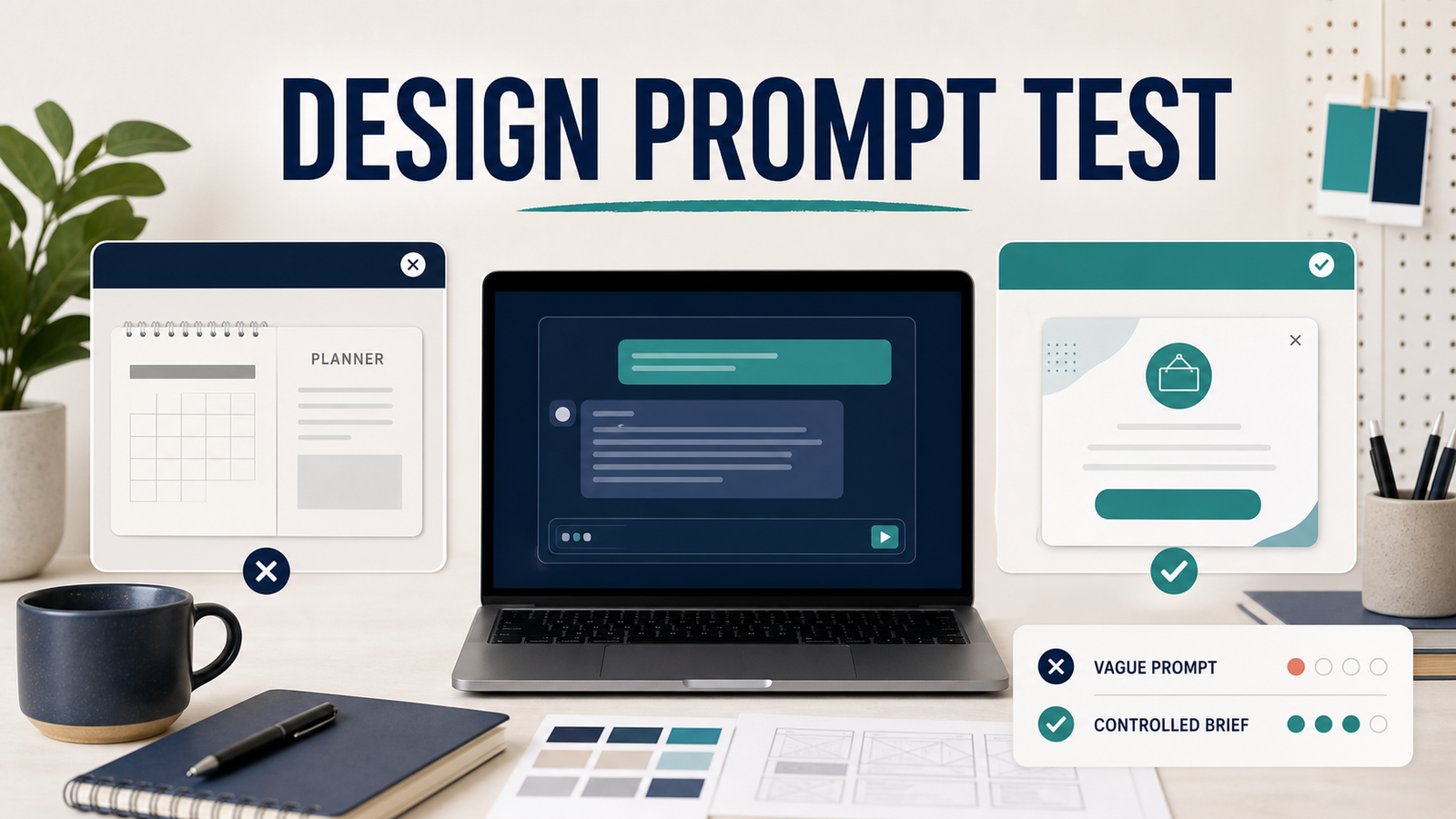
    A Practical Before-and-After Prompt Test

    Consider a common workplace task: telling a client that a project will be one week late. The two prompts below ask for the same deliverable, but they give ChatGPT very different amounts of useful information.

    Version 1: A vague request

    Write an email about a project delay.

    This request identifies the task, but not the recipient, reason, revised date, tone, or next step. ChatGPT has to make assumptions, so the draft may sound generic or include details that do not match the situation.

    Version 2: A structured request

    Write a concise email to an existing client explaining that the website redesign will be delivered on August 14 instead of August 7 because final accessibility testing needs more time.
    
    Acknowledge the inconvenience, take responsibility, and explain that the extra testing reduces the risk of problems after launch. Keep the tone calm and professional. Use a subject line, two short paragraphs, and a clear invitation to discuss any scheduling concerns. Do not invent discounts or additional project details.

    An illustrative result from the second prompt should be easier to use because the model no longer needs to guess the audience, facts, tone, structure, or prohibited details. The response can focus on communicating the delay instead of inventing the missing context.

    Why the second prompt is stronger

    • Task: Write a client email about a specific delay.
    • Context: The project, old date, new date, and reason are supplied.
    • Audience: The reader is an existing client.
    • Tone: Calm, professional, accountable, and concise.
    • Format: A subject line and two short paragraphs.
    • Boundary: The model is told not to invent compensation or project details.

    The lesson is not that every prompt must be long. It is that each instruction should remove an important ambiguity. If a detail will change whether the answer is usable, include it.

    Examples of Weak vs Strong Prompts

    Weak Prompt

    Write a blog post about AI.

    Better Prompt

    Write a 1,000-word beginner-friendly blog post about artificial intelligence.

    Use H2 and H3 headings, include practical examples, and keep the tone conversational.


    Weak Prompt

    Explain SEO.

    Better Prompt

    Explain SEO to a complete beginner using simple language.

    Include practical examples and a step-by-step guide.

    Common Prompt Formula

    A simple prompt structure is:

    Task

    Context

    Audience

    Format

    Tone

    Example:

    Write a 1,000-word blog post about AI productivity tools.
    
    Audience:
    Small business owners.
    
    Tone:
    Professional but easy to understand.
    
    Format:
    Use H2 and H3 headings with bullet points.

    Using a consistent prompt structure helps ChatGPT understand your request more accurately and produce better results.

    You can use this simple framework for almost any task, whether you’re writing emails, creating content, or planning projects.

    You can also use this framework in ChatGPT Study Mode to define your level, topic, goal, and preferred learning method before starting a guided study session.

    If you repeatedly ask for the same tone, response length, or formatting rules, save those preferences once with ChatGPT Custom Instructions and keep each task-specific prompt focused on the current goal.

    How to Diagnose a Weak ChatGPT Response

    When a response is disappointing, do not immediately rewrite the entire prompt. First identify the specific failure, then add the smallest instruction that addresses it.

    Problem in the responseLikely causePrompt improvement
    Too genericAudience, goal, or context is missingAdd who the answer is for and what decision or action it should support
    Too longNo length or priority was definedSet a word range and ask for only the most important points
    Wrong formatThe deliverable was not specifiedRequest a table, checklist, email, outline, or numbered steps
    Invented detailsThe model had to fill gapsSupply the facts and instruct it to label uncertainty instead of guessing
    Wrong toneThe relationship and tone were unclearDescribe the reader and use concrete tone words

    For an important factual task, add a verification instruction such as:

    Use only the information I provide and the sources you can verify. Separate confirmed facts from assumptions. If a claim cannot be verified, say so instead of guessing. Include links to the sources used.

    This instruction can reduce unsupported claims, but it does not guarantee accuracy. Review the sources yourself, especially for medical, legal, financial, safety, or other high-impact decisions. Our ChatGPT Search guide explains how to inspect citations and verify claims more carefully.

    OpenAI’s official prompt engineering best-practices guide likewise recommends clear, specific instructions, enough context, and iterative refinement after reviewing the first response.

    Common Mistakes to Avoid

    Avoid:

    • Being too vague
    • Missing context
    • Asking multiple questions at once
    • Forgetting the audience
    • Not reviewing the response

    Learn more:

    10 Common ChatGPT Prompt Mistakes

    If you’re new to ChatGPT, you may also enjoy:

    How to Use ChatGPT for Beginners

    Frequently Asked Questions

    Why are my ChatGPT answers too generic?

    Most generic responses happen because the prompt lacks enough detail or context.


    How long should a ChatGPT prompt be?

    There is no perfect length. A prompt should contain enough information for ChatGPT to understand your request.


    Can better prompts improve ChatGPT’s answers?

    Yes. Better prompts often lead to more accurate, detailed, and useful responses.


    Should I use ChatGPT or Google?

    ChatGPT is excellent for generating ideas, writing, and explaining concepts, while Google is better for finding recent information and official sources.

    Learn more:

    ChatGPT vs Google


    Can I reuse the same prompt?

    Yes.

    You can reuse prompts, but adjusting them to your audience, goals, and context usually produces better responses.

    Conclusion

    Better prompting is less about finding a secret phrase and more about reducing ambiguity. State the task, provide the context that affects the answer, identify the audience, define the output format, and set useful boundaries.

    Then review the response as a draft. If it is generic, inaccurate, too long, or poorly structured, diagnose that specific problem and refine one part of the prompt. This conversational approach is usually more effective than trying to write a perfect instruction on the first attempt.

    Clear prompts can improve relevance and reduce revisions, but they do not guarantee factual accuracy. Verify important claims with reliable primary sources and never treat a confident answer as proof.

    For repeated work, save the reusable structure and replace only the changing context. Over time, a small library of tested prompt templates can make ChatGPT more useful for writing, learning, planning, and everyday work.

  • Best ChatGPT Prompts for Work: 20 Practical Examples (2026 Guide)

    Best ChatGPT Prompts for Work: 20 Practical Examples (2026 Guide)

    The best ChatGPT prompts for work can help professionals save time, improve productivity, and complete everyday business tasks more efficiently.

    Whether you’re writing emails, planning projects, or organizing meetings, using well-written prompts can significantly improve the quality of ChatGPT’s responses.

    However, the quality of ChatGPT’s responses depends largely on the prompts you provide. A well-written prompt can produce accurate, useful, and professional results, while a vague prompt often leads to generic answers.

    In this guide, you’ll discover 20 practical ChatGPT prompts for work that professionals can use for emails, meetings, project planning, research, marketing, presentations, customer communication, and more.

    Whether you’re an employee, freelancer, manager, or business owner, these prompts can help you work faster and more efficiently.

    Why Use ChatGPT Prompts at Work?

    Best ChatGPT prompts for work including email writing, project planning, meetings, research, and productivity.

    ChatGPT can support professionals in almost every industry by reducing repetitive work and helping generate ideas more efficiently.

    With the right prompts, you can:

    • Write professional emails
    • Plan projects
    • Organize meetings
    • Summarize documents
    • Brainstorm ideas
    • Create reports
    • Improve communication
    • Increase productivity

    If you’re new to ChatGPT, start with our beginner guide:

    How to Use ChatGPT for Work

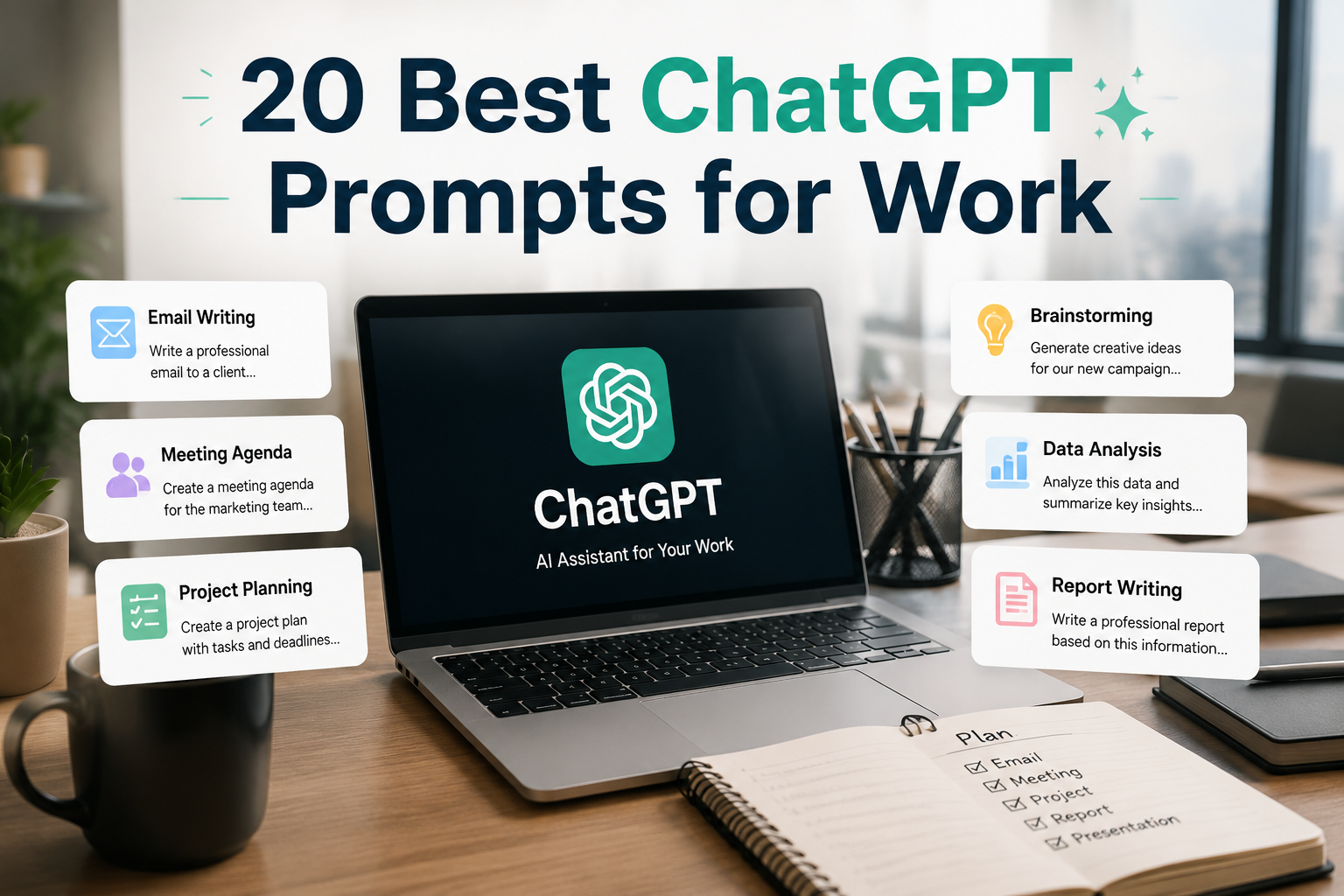
    20 Best ChatGPT Prompts for Work

    20 professional ChatGPT prompts for work including email writing, meeting agendas, project planning, research, marketing, presentations, customer support, and reports.

    The following best ChatGPT prompts for work cover the most common professional tasks.

    1. Write Professional Emails

    Writing professional emails often takes more time than expected.

    ChatGPT can help you create clear, polite, and well-structured emails for clients, coworkers, and business partners.

    Example Prompt

    Write a professional email to a client explaining a one-week project delay.
    
    Keep the tone polite, positive, and solution-focused.

    You can also ask ChatGPT to make the email shorter, more formal, or friendlier depending on the situation.

    2. Create Meeting Agendas

    A clear meeting agenda keeps discussions focused and saves time.

    ChatGPT can quickly organize meeting topics and priorities.

    Example Prompt

    Create a one-hour meeting agenda for a weekly marketing team meeting.

    Include discussion topics, time allocations, and action items.

    3. Summarize Meeting Notes

    After meetings, organizing notes into clear summaries can be time-consuming.

    ChatGPT can identify the most important points and generate action items.

    Example Prompt

    Summarize these meeting notes into five key takeaways and create a list of action items.

    4. Plan Projects

    Managing projects becomes easier when tasks are organized into clear steps.

    ChatGPT can help build project timelines and task lists.

    Example Prompt

    Create a project plan for launching a new company website within six weeks.
    
    Include milestones, deadlines, and responsibilities.

    5. Organize Weekly Tasks

    Professionals often juggle multiple priorities.

    ChatGPT can organize tasks based on urgency and importance.

    Example Prompt

    Create a weekly work schedule based on these tasks.
    
    Prioritize urgent work while balancing meetings and focused work sessions.

    6. Brainstorm New Ideas

    Generating fresh ideas is easier when you have an AI brainstorming partner.

    ChatGPT can suggest multiple creative approaches to the same problem.

    Example Prompt

    Generate ten creative marketing ideas for a new coffee shop targeting young professionals.
    Include both online and offline marketing strategies.

    7. Research Topics Faster

    Research often involves reading multiple articles and comparing information.

    ChatGPT can summarize concepts and explain complicated topics in simple language.

    Example Prompt

    Explain blockchain technology for business professionals using simple language and practical examples.

    8. Analyze Business Data

    ChatGPT can help interpret reports and identify patterns within business data.

    Always verify important decisions using reliable data sources.

    Example Prompt

    Analyze this quarterly sales report and identify the three most important business insights.

    9. Write Professional Reports

    Reports should be clear, organized, and easy to understand.

    ChatGPT can improve clarity and structure.

    Example Prompt

    Rewrite this project report using a professional business tone.
    
    Organize the content into clear sections with headings.

    10. Create Presentation Outlines

    Instead of starting from a blank page, ChatGPT can quickly generate presentation structures.

    Example Prompt

    Create a 10-slide presentation outline about digital marketing trends in 2026.
    
    Include key talking points for each slide.

    11. Generate Marketing Ideas

    Marketing teams constantly need fresh campaign ideas and promotional strategies.

    ChatGPT can generate creative ideas based on your target audience, industry, and business goals.

    Example Prompt

    Generate 15 marketing campaign ideas for a cosmetic clinic targeting women in their 30s.
    
    Include social media, email, and offline marketing ideas.

    Providing your audience and business goals will produce much more relevant ideas.

    12. Reply to Customer Messages

    Responding to customer inquiries consistently can improve customer satisfaction.

    ChatGPT can help create professional and friendly responses for emails, live chat, and customer support.

    Example Prompt

    Write a polite reply to a customer requesting a refund.
    
    Show empathy, explain the company policy, and offer an alternative solution.

    13. Write Social Media Posts

    Creating engaging social media content every day can be challenging.

    ChatGPT can generate captions for Instagram, LinkedIn, Facebook, Threads, and X.

    Example Prompt

    Write five LinkedIn posts promoting AI productivity tools.
    
    Use a professional tone and include a question to encourage engagement.

    14. Create Blog Outlines

    Planning a blog becomes much easier when you have a clear structure before writing.

    ChatGPT can generate SEO-friendly outlines that organize your ideas logically.

    Example Prompt

    Create an SEO-friendly blog outline for the topic "Benefits of Artificial Intelligence for Small Businesses."
    
    Include H2 and H3 headings.

    15. Perform a SWOT Analysis

    A SWOT analysis helps evaluate strengths, weaknesses, opportunities, and threats.

    ChatGPT can quickly organize information into a clear business framework.

    Example Prompt

    Create a SWOT analysis for a small online clothing business entering a competitive market.

    16. Create Standard Operating Procedures (SOPs)

    Well-written SOPs help teams maintain consistency.

    ChatGPT can organize step-by-step workflows into professional documentation.

    Example Prompt

    Create a standard operating procedure for onboarding a new employee in a marketing department.

    17. Prioritize Daily Tasks

    Managing multiple deadlines becomes easier when tasks are properly prioritized.

    ChatGPT can organize work using urgency, importance, and estimated completion time.

    Example Prompt

    Prioritize these tasks using the Eisenhower Matrix and explain why.

    18. Translate Business Documents

    ChatGPT can translate documents while keeping a natural business tone.

    Always review important translations before sending them to clients.

    Example Prompt

    Translate this business proposal into professional English while maintaining a formal tone.

    19. Prepare Interview Questions

    Hiring managers can use ChatGPT to generate interview questions for different positions.

    Example Prompt

    Create ten behavioral interview questions for hiring a digital marketing specialist.

    20. Compare Business Decisions

    Sometimes choosing between multiple options can be difficult.

    ChatGPT can compare advantages and disadvantages objectively.

    Example Prompt

    Compare the advantages and disadvantages of outsourcing customer support versus hiring an in-house team.
    
    Present the answer as a comparison table.

    A Practical Workflow: Turn Messy Meeting Notes into an Action Plan

    Copying a prompt is only the first step. The useful part is giving ChatGPT enough context, reviewing the output, and correcting anything the model inferred without evidence.

    Consider a realistic situation: a project manager has rough notes from a 30-minute launch meeting. The notes contain decisions, possible deadlines, unanswered questions, and tasks whose owners are not yet confirmed. Instead of asking ChatGPT to “summarize this,” use a prompt that separates facts from assumptions.

    Reusable prompt

    I will paste rough notes from a project meeting.
    
    Create four sections:
    1. Confirmed decisions
    2. Action items in a table with task, owner, deadline, and status
    3. Open questions
    4. Risks or dependencies
    
    Use only information stated in the notes. If an owner or deadline is missing, write “Not confirmed” instead of guessing. After the table, list any statements that may need verification.
    
    Meeting notes:
    [Paste the notes here]

    How to Judge the Result

    A polished answer is not automatically a correct answer. Compare the response with the original notes and check four things:

    • Ownership: Did ChatGPT assign a task to someone who was only mentioned in the discussion?
    • Deadlines: Did it convert a tentative date into a confirmed commitment?
    • Missing context: Did the summary leave out a constraint, dependency, or objection?
    • Unsupported conclusions: Did it add a recommendation that was not present in the notes?

    If any item is uncertain, revise the prompt or correct the draft before sharing it. For longer assignments that use the same reference files and instructions repeatedly, our ChatGPT Projects guide explains how to keep that work in a focused workspace.

    Protect Sensitive Work Information

    Do not paste confidential client data, passwords, private financial records, employee information, or unpublished business plans into an AI tool unless your organization has approved that use. Replace names and identifying details with placeholders when possible, and follow your employer’s security and retention policies.

    If you want to revise a long draft section by section, see our ChatGPT Canvas guide for a more controlled editing workflow.

    Tips for Writing Better Work Prompts

    Give Clear Instructions

    The clearer your instructions, the better ChatGPT can understand your request.

    Avoid vague prompts and explain exactly what you want to achieve.

    For more prompt-writing tips, read our guide:

    10 Common ChatGPT Prompt Mistakes

    Provide Enough Context

    Include useful background information whenever possible.

    Helpful details include:

    • Your goal
    • Your audience
    • Your preferred format
    • The desired tone
    • Any important limitations

    For more ready-to-use examples, check out:

    Best ChatGPT Prompts for Beginners

    Keep Improving the Conversation

    Your first prompt doesn’t have to be perfect.

    Ask ChatGPT to rewrite, shorten, expand, simplify, or improve its previous response.

    The best results usually come from an ongoing conversation rather than a single request.

    Frequently Asked Questions

    Can ChatGPT improve productivity at work?

    Yes. ChatGPT can help professionals write documents, organize projects, summarize information, generate ideas, and automate repetitive tasks, allowing them to focus on higher-value work.

    Are these prompts suitable for beginners?

    These best ChatGPT prompts for work are suitable for employees, freelancers, business owners, and managers.

    Absolutely. Most of the prompts in this guide are simple enough for beginners to copy, modify, and use immediately.

    Can ChatGPT replace employees?

    No. ChatGPT is designed to assist people, not replace human judgment, creativity, communication, and decision-making.

    Should I verify ChatGPT’s answers?

    Yes. Always verify important information, especially when making financial, legal, medical, or business decisions.

    For more information about when to use ChatGPT or traditional search engines, read:

    ChatGPT vs Google

    Conclusion

    Best ChatGPT Prompts for Work can help professionals save time, improve productivity, and communicate more effectively.

    These best ChatGPT prompts for work can easily be customized for your own industry and daily workflow.

    Whether you’re writing emails, planning projects, brainstorming ideas, or creating presentations, using clear prompts will consistently produce better results.

    Start by trying a few of the prompts in this guide, customize them to fit your workflow, and continue refining your conversations with ChatGPT.

    The more you practice writing effective prompts, the more valuable ChatGPT will become in your daily work.

    ChatGPT is developed by OpenAI. To learn more about ChatGPT and its latest features, visit the official OpenAI website.

  • How to Use ChatGPT for Work: 10 Practical Examples

    How to Use ChatGPT for Work: 10 Practical Examples

    Many professionals are looking for ways to save time, improve productivity, and work more efficiently with AI.

    ChatGPT is an AI assistant developed by OpenAI that helps users write, research, organize information, and complete tasks more efficiently.

    How to Use ChatGPT for Work is becoming an important skill as more people use AI tools for writing, research, planning, and everyday business tasks.

    ChatGPT is not designed to replace human creativity or decision-making. Instead, it can help you complete repetitive tasks faster, organize your thoughts, and create better results.

    In this guide, you’ll learn 10 practical ways to use ChatGPT at work, including writing emails, summarizing information, creating content, planning projects, and improving productivity.

    How to Use ChatGPT for Work

    How to Use ChatGPT for Work

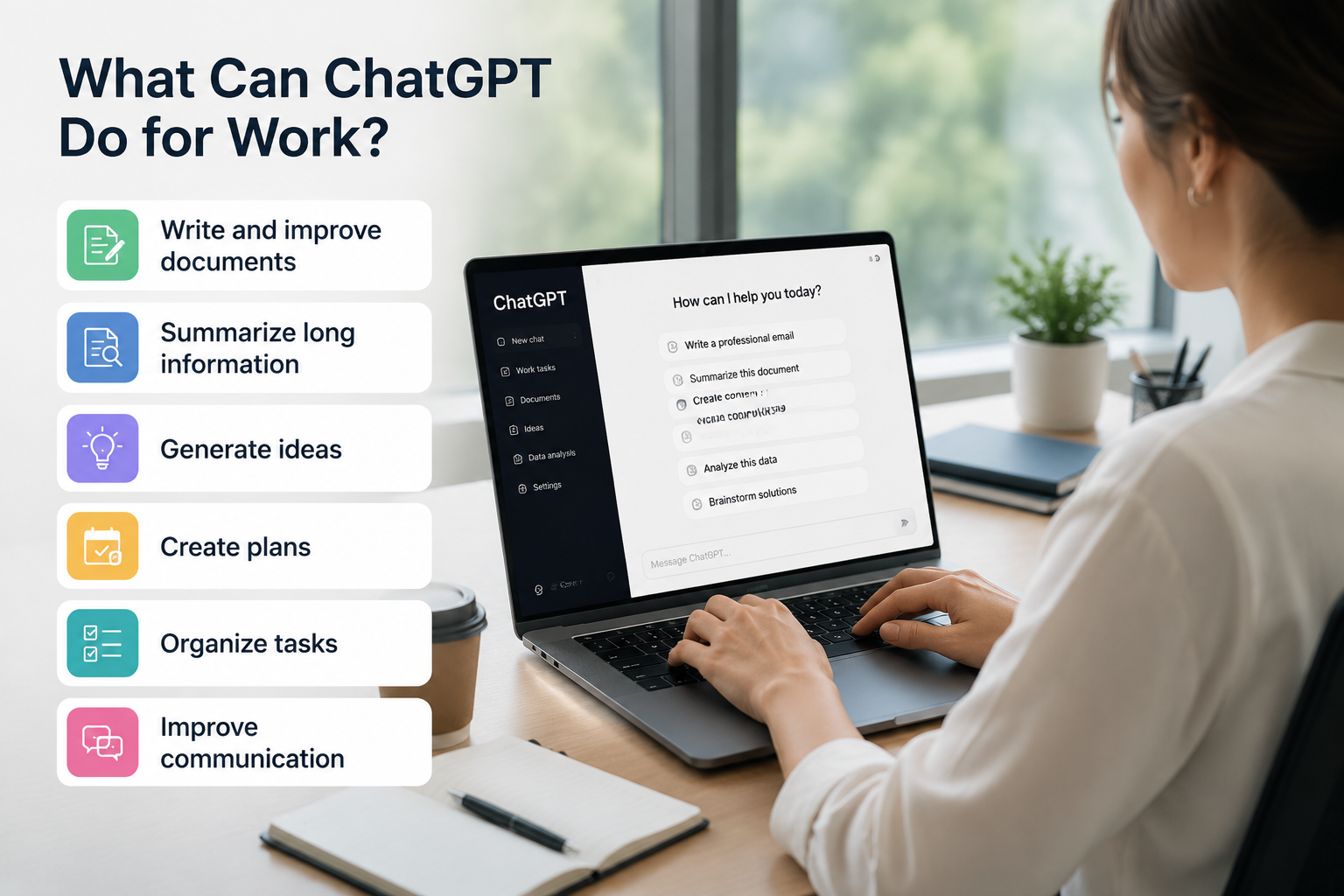
    ChatGPT can assist with many different workplace tasks.

    Whether you are an employee, business owner, freelancer, or creator, ChatGPT can help you:

    • Write and improve documents
    • Summarize long information
    • Generate ideas
    • Create plans
    • Organize tasks
    • Improve communication

    If you are new to ChatGPT, start with our beginner guide: How to Use ChatGPT for Beginners.

    ChatGPT work use cases

    1. Writing Professional Emails

    Writing emails can take a lot of time, especially when you need the right tone and structure.

    ChatGPT can help you create professional emails, rewrite unclear messages, and adjust the tone depending on the situation.

    Example Prompt

    Write a professional email to a client explaining a project delay.
    Keep the tone polite and solution-focused.

    You can also ask ChatGPT to make an email shorter, friendlier, or more formal.

    2. Summarizing Long Documents

    Professionals often need to read reports, meeting notes, and research documents.

    ChatGPT can quickly summarize long content and highlight important information.

    Example Prompt

    Summarize this document into five key points.

    This can help you understand large amounts of information faster.

    3. Creating Content Ideas

    Content creation requires constant brainstorming.

    ChatGPT can help generate ideas for:

    • Blog posts
    • Social media content
    • Marketing campaigns
    • Video topics

    Example Prompt

    Create 10 content ideas for a small business.

    You can provide your industry, audience, and goals to get more relevant ideas.

    4. Creating To-Do Lists and Work Plans

    Managing multiple tasks can become difficult.

    ChatGPT can help organize your tasks into clear schedules and action plans.

    Example Prompt

    Create a weekly work schedule based on these tasks.

    You can also ask ChatGPT to prioritize tasks based on urgency and importance.

    5. Improving Writing Quality

    ChatGPT can help improve existing writing by making it clearer and more professional.

    It can help with:

    • Emails
    • Reports
    • Presentations
    • Articles
    • Business documents

    Example Prompt

    Rewrite this paragraph to sound more professional.

    Small improvements in wording can make your communication more effective.

    6. Research and Learning

    Learning new topics is an important part of many jobs.

    ChatGPT can explain complex topics in simple language and provide examples.

    Example Prompt

    Explain this topic like I'm a beginner.

    You can also ask ChatGPT to compare concepts, create summaries, or explain ideas step by step.

    7. Preparing Meetings

    Preparing for meetings often requires creating agendas, questions, and summaries.

    ChatGPT can help organize meetings more efficiently.

    Example Prompt

    Create a meeting agenda for a marketing team.

    You can also use ChatGPT to summarize previous meeting notes and create follow-up tasks.

    8. Creating Presentations

    Creating a presentation from scratch can take hours.

    ChatGPT can help you create:

    • Presentation outlines
    • Slide structures
    • Key talking points
    • Speaker notes

    Example Prompt

    Create a presentation outline about digital marketing.

    You can then customize the content based on your audience.

    9. Analyzing Data

    ChatGPT can help you understand data and find patterns.

    It can assist with:

    • Explaining data trends
    • Summarizing reports
    • Organizing information

    Example Prompt

    Analyze this data and explain the main insights.

    However, always verify important business decisions with accurate data sources.

    10. Brainstorming Solutions

    When facing a problem, generating multiple ideas can help you find better solutions.

    ChatGPT can act as a brainstorming partner by suggesting different approaches.

    Example Prompt

    Give me five possible solutions to this business problem.

    You can continue the conversation by asking ChatGPT to compare the advantages and disadvantages of each idea.

    A Practical Workflow: Turn Meeting Notes into Action Items

    A useful workplace test is to give ChatGPT a small set of meeting notes and ask for an action list that a team can actually review. The goal is not to let AI make decisions; it is to reduce the time spent organizing information.

    Example Prompt

    I will paste meeting notes below. Turn them into a table with four columns: action item, owner, deadline, and open question. Do not invent missing owners or dates; write “Not specified” instead. After the table, list any decision that still needs confirmation. Keep the wording concise.
    
    [Paste meeting notes here]

    How to interpret the result: a useful response separates confirmed tasks from unresolved questions. If ChatGPT assigns a person or deadline that does not appear in the notes, the output needs correction. This check is more important than how polished the table looks.

    Before sharing the result, compare every owner, date, number, and commitment with the original notes. Remove confidential client data, passwords, private employee information, and other sensitive material before entering workplace content into an AI tool.

    If you repeat the same type of task, you can store general preferences such as tone and formatting with ChatGPT Custom Instructions. Keep project-specific or confidential details out of permanent instructions.

    Best Practices for Using ChatGPT at Work

    Using ChatGPT effectively depends on how you communicate your instructions.

    Give Clear Instructions

    The better your prompt, the better your results will be.

    Avoid vague requests and provide enough context about your goal.

    Learn more about writing better prompts in our guide: 10 Common ChatGPT Prompt Mistakes

    Provide Enough Context

    ChatGPT works better when it understands your situation.

    Include details such as:

    • Your audience
    • Your goal
    • Your preferred format
    • Important background information

    For more prompt examples, check out our guide: Best ChatGPT Prompts for Beginners

    Review Important Information

    ChatGPT is a powerful assistant, but it can occasionally provide incorrect information.

    Always verify important information, especially for:

    • Business decisions
    • Financial information
    • Legal topics
    • Medical topics

    Learn more about choosing the right AI tool: ChatGPT vs Google

    Frequently Asked Questions

    Can ChatGPT improve productivity at work?

    Yes. ChatGPT can help reduce repetitive tasks, organize information, create drafts, and support better decision-making.

    Is ChatGPT useful for small businesses?

    Yes. Small business owners can use ChatGPT for marketing ideas, customer communication, content creation, and planning.

    Can ChatGPT replace employees?

    No. ChatGPT is a tool that helps people work more efficiently. Human judgment, creativity, and decision-making are still essential.

    Is ChatGPT safe to use at work?

    ChatGPT can be useful at work, but you should avoid entering confidential company information, passwords, or sensitive data.

    Conclusion

    Learning How to Use ChatGPT for Work can help professionals across many industries improve productivity and save time.

    By using ChatGPT for emails, research, writing, planning, and brainstorming, you can save time and focus on more important tasks.

    If you handle recurring work, learn how to use ChatGPT Projects to keep related chats, files, and instructions together in one focused workspace.

    When you are ready to move beyond general ideas, use our 20 practical ChatGPT prompts for work and follow the meeting-notes workflow to review owners, deadlines, and unsupported assumptions before sharing the result.

    The key is not simply using AI, but learning how to communicate with it effectively.

    Start with simple tasks, experiment with different prompts, and gradually discover how ChatGPT can improve your daily workflow.

  • ChatGPT vs Google: What’s the Difference? (2026 Guide)

    ChatGPT vs Google: What’s the Difference? (2026 Guide)

    ChatGPT vs Google is a common question for beginners who want to understand which tool is better for finding information, learning, and getting work done. Both tools can help you find information, but they work in very different ways.

    Google is designed to help you search the web and find existing information from websites. ChatGPT is designed to understand your questions, generate responses, and help you complete tasks through conversation.

    Understanding the difference between ChatGPT and Google will help you choose the right tool for writing, learning, research, and everyday problem-solving.

    What Is ChatGPT?

    ChatGPT is an AI assistant developed by OpenAI that understands natural language and generates human-like responses.

    Instead of searching through multiple websites, you can ask ChatGPT questions, request explanations, create content, summarize information, brainstorm ideas, and solve problems through a conversation.

    ChatGPT is especially useful when you need help creating something, understanding a topic, or improving your work.

    If you’re new to ChatGPT, our beginner guide explains how to get started:

    How to Use ChatGPT for Beginners

    What Is Google Search?

    Google is a search engine that helps you find information available on the internet.

    When you search for something, Google analyzes billions of web pages and shows relevant results, including websites, articles, images, maps, videos, and official sources.

    Google is especially useful when you need:

    • The latest news
    • Current prices
    • Official documents
    • Local information
    • Specific websites

    ChatGPT vs Google: Key Differences

    The biggest difference between ChatGPT and Google is how they provide information.

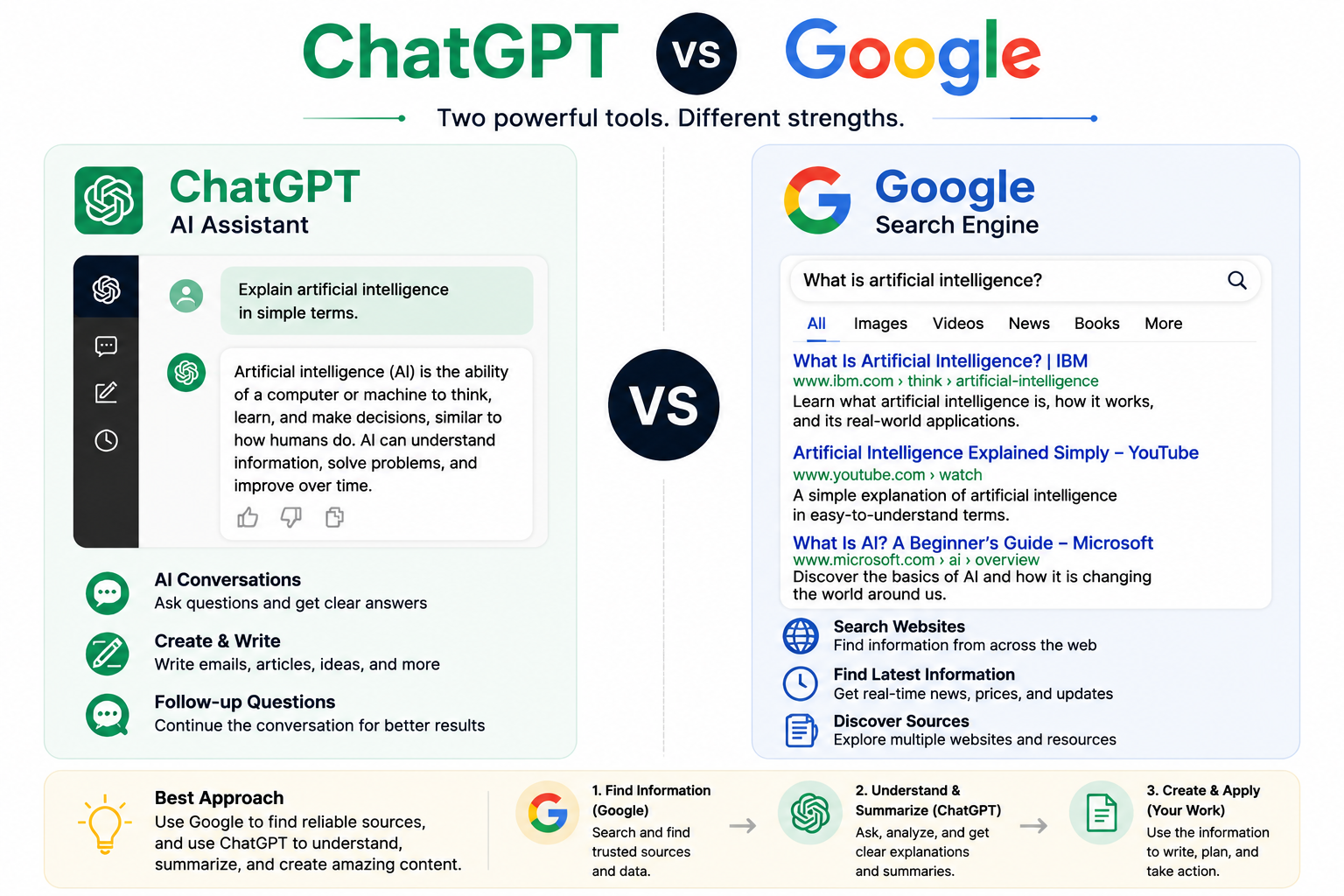
    ChatGPT vs Google comparison
    FeatureChatGPTGoogle
    Main purposeConversation and AI assistanceFinding information online
    Best forWriting, explanations, brainstormingSearching websites and current information
    Response styleGenerated answersSearch results
    InteractionFollow-up conversationsNew searches
    Information sourceAI-generated responsesWebsites across the internet

    When Should You Use ChatGPT?

    ChatGPT is most useful when you need help creating, understanding, or organizing information.

    Writing Help

    ChatGPT can help you:

    • Write emails
    • Create blog posts
    • Rewrite sentences
    • Improve your writing style

    Example prompt:

    Write a professional email requesting a meeting next week.

    Small changes to your instructions can significantly improve the quality of the response.

    Learning and Explanations

    ChatGPT can explain difficult topics in simple language.

    Example prompt:

    Explain artificial intelligence to a 12-year-old using simple language.

    You can also ask ChatGPT to provide examples, create summaries, or explain concepts step by step.

    Brainstorming Ideas

    ChatGPT is useful for generating:

    • Business ideas
    • Content ideas
    • Marketing strategies
    • Project plans

    It can help you organize your thoughts and explore different possibilities quickly.

    When Should You Use Google?

    Google is better when you need information from the internet, especially information that changes frequently.

    Current Information

    Use Google for:

    • Today’s news
    • Stock prices
    • Weather
    • Events
    • Real-time updates

    Official Sources

    Google is useful when you need:

    • Government websites
    • Company announcements
    • Documentation
    • Research papers

    Local Information

    Google is often better for:

    • Restaurants
    • Stores
    • Directions
    • Nearby services

    A Practical Test: Use ChatGPT and Google for the Same Question

    The difference becomes clearer when both tools are used for one real task. Imagine that you are preparing for a flight and want to know the current rules for carrying lithium batteries.

    Step 1: Use ChatGPT to Understand the Topic

    Start by asking ChatGPT for an organized explanation and a list of details that still need verification:

    Explain the general rules for carrying lithium batteries on a passenger flight. Separate carry-on and checked-baggage guidance, list the details I need to confirm, and do not assume that every airline follows exactly the same policy.

    A useful response should separate battery types, identify details such as watt-hours and spare batteries, and remind you that airline and government rules may differ. This is valuable for orientation, but it is not the final authority. A confident answer can still be incomplete, outdated, or based on the wrong jurisdiction.

    Step 2: Use Google to Find the Primary Source

    Next, search for a current government or airline page rather than relying on a summary alone. A focused query could be:

    site:faa.gov lithium batteries passenger baggage

    Open the official result and check its publication or update date, the country it covers, battery limits, and any airline-specific exceptions. Google helps you locate the source, but you still need to judge whether the page is authoritative and relevant to your trip.

    Step 3: Compare the Answer with the Source

    • Does the ChatGPT summary match the official page?
    • Are any dates, limits, or exceptions missing?
    • Does the advice apply to your country and airline?
    • Can you explain the rule in your own words after checking it?

    This workflow shows the practical difference: ChatGPT is useful for explaining and organizing a question, while Google is useful for locating current primary sources. For legal, medical, financial, safety, or travel decisions, verify the important details on the original source before acting.

    OpenAI also advises users to treat ChatGPT as a starting point and verify important information from reliable sources. You can read its guidance in Does ChatGPT tell the truth?. Google explains how Search organizes information and aims to surface relevant, reliable results in How Search Works.

    If the research will continue over several days, save the verified sources and instructions in one workspace. Our ChatGPT Projects guide explains a practical way to keep related chats, files, and context together.

    Can ChatGPT Replace Google?

    When comparing ChatGPT vs Google, the short answer is:

    No, ChatGPT cannot completely replace Google.

    Using ChatGPT and Google together

    ChatGPT and Google are different tools designed for different purposes.

    ChatGPT is excellent for:

    • Understanding concepts
    • Creating content
    • Organizing ideas
    • Having conversations

    Google is excellent for:

    • Finding websites
    • Checking recent information
    • Discovering reliable sources

    The best approach is to use both tools together.

    For example:

    1. Use Google to find reliable sources.
    2. Use ChatGPT to summarize and explain the information.
    3. Use ChatGPT to organize your ideas or create content.

    How to Get Better Results from ChatGPT

    The quality of ChatGPT’s answers depends heavily on the quality of your prompts.

    Instead of asking:

    Tell me about marketing.

    Try:

    Explain digital marketing for a small coffee shop in simple terms with three practical examples.

    A clear goal, enough context, and a specific format usually lead to better results.

    For more examples, check out:

    Best ChatGPT Prompts for Beginners

    Common Mistakes When Comparing ChatGPT and Google

    Many beginners expect ChatGPT to work exactly like a search engine.

    However, ChatGPT and Google are designed for different purposes.

    Common mistakes include:

    • Asking ChatGPT for information that changes every minute
    • Not verifying important information
    • Using vague prompts
    • Expecting one perfect answer immediately

    Learn how to avoid common prompt mistakes:

    10 Common ChatGPT Prompt Mistakes

    Frequently Asked Questions

    Is ChatGPT better than Google?

    Neither tool is always better.

    ChatGPT is better for conversations, explanations, and creating content, while Google is better for finding current information and websites.

    Can ChatGPT search the internet?

    ChatGPT can access current information in some versions and situations, but it works differently from traditional search engines like Google.

    Should beginners use ChatGPT or Google?

    Beginners should learn to use both.

    Use Google when you need sources and current information, and use ChatGPT when you need explanations, ideas, or help creating something.

    Is ChatGPT free?

    ChatGPT offers a free version, while paid plans provide additional features and higher usage limits.

    Conclusion

    ChatGPT and Google are not competitors where one tool must replace the other.

    They are different tools designed for different purposes.

    Google helps you find information from the web, while ChatGPT helps you understand information and create new content through conversation.

    Once you understand when to use each tool, you can save time, learn faster, and become more productive.

    The best digital skill today is not choosing between ChatGPT and Google—it is knowing how to use both effectively.

  • 10 Common ChatGPT Prompt Mistakes (And How to Fix Them)

    10 Common ChatGPT Prompt Mistakes (And How to Fix Them)

    Many beginners think ChatGPT automatically understands exactly what they need. In reality, the quality of your prompt has a direct impact on the quality of the response you receive.

    Even small mistakes—such as being too vague or forgetting important details—can lead to inaccurate, incomplete, or unhelpful answers.

    The good news is that most prompt mistakes are easy to fix. In this guide, you’ll learn the most common ChatGPT prompt mistakes, see practical examples, and discover simple techniques to write better prompts that produce better AI responses.

    Why Common ChatGPT Prompt Mistakes Matter

    ChatGPT doesn’t read your mind—it follows your instructions.

    The clearer and more specific your prompt is, the easier it is for ChatGPT to understand exactly what you’re asking. Better prompts lead to more accurate answers, save time, and reduce the need for multiple follow-up questions.

    Learning how to write effective prompts is one of the fastest ways to improve your experience with ChatGPT, whether you’re using it for work, studying, writing, coding, or everyday tasks.

    1. Being Too Vague

    One of the biggest mistakes beginners make is writing prompts that are too vague.

    When your request doesn’t include enough detail, ChatGPT has to guess what you mean. As a result, the response is often too general to be useful.

    Instead of asking broad questions, clearly explain what you want, who it’s for, and what outcome you’re expecting.

    Bad Prompt

    Tell me about marketing.

    Better Prompt

    Explain digital marketing for a small coffee shop in simple terms with three practical examples.

    Notice how the second prompt provides a clear topic, audience, and expected level of detail. This allows ChatGPT to generate a much more useful response.

    2. Not Giving Enough Context

    Context is one of the most important parts of a good prompt.

    Without background information, ChatGPT has to make assumptions about your situation. Those assumptions may not match what you actually need.

    Whenever possible, explain your goal, audience, experience level, or any other information that helps define the task.

    Bad Prompt

    Write an email.

    Better Prompt

    Write a professional email to a client who missed our meeting yesterday. Keep the tone polite and under 150 words.

    The additional context makes it much easier for ChatGPT to produce a response that fits your situation.

    3. Asking Too Many Questions at Once

    Many beginners try to solve several problems in a single prompt.

    Although ChatGPT can handle complex requests, asking too many unrelated questions at once often leads to incomplete or confusing responses. Instead of trying to accomplish everything in one message, break large tasks into smaller, focused prompts.

    This approach allows ChatGPT to provide more detailed, organized, and accurate answers.

    Bad Prompt

    Explain SEO, create a marketing plan, and write five Instagram captions.

    Better Prompt

    First, explain SEO for beginners.
    
    Then create a simple marketing plan for a local coffee shop.
    
    Finally, write five Instagram captions based on that marketing plan.

    Breaking your request into logical steps helps ChatGPT stay focused and deliver much better results.

    4. Ignoring the Desired Output Format

    One of the easiest ways to improve ChatGPT’s responses is to tell it exactly how you want the answer to be presented.

    If you don’t specify a format, ChatGPT will choose one for you—and it may not match what you expected.

    You can request bullet points, tables, summaries, step-by-step guides, emails, blog posts, or even checklists.

    Bad Prompt

    Explain artificial intelligence.

    Better Prompt

    Explain artificial intelligence in five bullet points using simple language for beginners.

    Being specific about the format saves time and often eliminates the need to rewrite the response later.

    5. Ending the Conversation Too Early

    Many users treat ChatGPT like a search engine by asking one question and stopping after the first answer.

    However, ChatGPT works best as an ongoing conversation.

    If the first response isn’t exactly what you need, ask follow-up questions to refine the result.

    For example, you can ask ChatGPT to:

    • Explain it more simply.
    • Give three additional examples.
    • Rewrite the response in a professional tone.
    • Turn the answer into a table.
    • Make the explanation shorter.
    • Expand one specific section.

    The more you guide the conversation, the more useful and personalized the responses become.

    Example of a clear ChatGPT prompt

    6. Not Defining the Audience

    A prompt can be specific about the task and still produce the wrong tone if ChatGPT does not know who will read the result. A beginner, an executive, and a technical specialist need different vocabulary, detail, and examples.

    Bad Prompt

    Explain cybersecurity.

    Better Prompt

    Explain phishing to new employees with no technical background. Use plain English, one realistic email example, and a five-point safety checklist.

    Defining the audience helps ChatGPT choose the right depth and language. Before submitting a prompt, name the reader’s experience level and what they need to do with the answer.

    7. Forgetting Constraints and Boundaries

    Without limits, ChatGPT may create an answer that is too long, too broad, or unsuitable for your situation. Useful constraints include word count, deadline, budget, location, available tools, and topics that must be excluded.

    Bad Prompt

    Create a marketing plan for my small business.

    Better Prompt

    Create a 30-day marketing plan for a local bakery with a $500 budget. Focus on Instagram and email, exclude paid influencers, and present the plan as a weekly table.

    Constraints reduce guesswork. They do not make the prompt unnecessarily complicated; they make the response easier to use.

    8. Trusting the First Answer Without Checking

    A well-written response can still contain missing context, weak assumptions, or factual errors. Good prompting includes a review step instead of treating the first answer as final.

    Bad Prompt

    Give me the final answer and make it sound confident.

    Better Prompt

    Draft the answer, then list the three assumptions you made, identify any claim that needs verification, and suggest reliable primary sources I should check.

    For medical, legal, financial, academic, or other high-stakes decisions, verify important information with qualified professionals and reliable primary sources. A stronger prompt improves usefulness, but it does not guarantee accuracy.

    9. Asking for Facts Without Sources or Dates

    Information about prices, policies, software, statistics, and public figures can change. If the date and source matter, request them directly and check that the cited material actually supports the claim.

    Bad Prompt

    What are the latest remote-work statistics?

    Better Prompt

    Summarize three recent remote-work statistics from government reports or original research. Include the publication date, source link, sample size when available, and clearly label any inference.

    This instruction makes the evidence easier to inspect. Always open important sources yourself because links, dates, and summaries can still be incorrect or incomplete.

    10. Reusing the Same Prompt for Every Task

    A prompt that works for brainstorming may not work for research, editing, analysis, or decision-making. Each task needs its own success criteria, inputs, and output format.

    Bad Prompt

    Help me with this project.

    Better Prompt

    I am planning a beginner guide about email productivity. First identify the reader's three main problems, then propose an outline with six H2 sections. Do not write the full article until I approve the outline.

    Adapting the prompt to the stage of work produces more controlled results. For longer assignments, you can also organize chats, files, and instructions with ChatGPT Projects.

    A Simple Prompt Quality Test

    You can test prompt quality without relying on a vague feeling that one answer “looks better.” Run the same practical task twice in a new chat, change only the prompt, and compare the responses with a short checklist.

    Test scenario: a customer cancellation email

    Vague prompt:

    Write a cancellation email.

    Controlled prompt:

    Write a customer email confirming the cancellation of a monthly software subscription.
    Audience: a customer who requested cancellation today.
    Tone: calm, respectful, and professional.
    Include: confirmation that auto-renewal is stopped, access continues through July 31, and a support contact for billing questions.
    Do not invent a refund or policy.
    Format: subject line plus a body of no more than 120 words.

    Review both outputs using the same four questions:

    1. Does the first sentence make the purpose clear?
    2. Are the audience, tone, and required details reflected in the response?
    3. Did the response obey the length and format limits?
    4. Did it avoid inventing refunds, dates, or policies that were not provided?

    How to interpret the result

    The controlled prompt should make it easier to judge whether the response fits the task because the success conditions are visible. However, a well-structured answer is not automatically a factually correct one. Names, dates, prices, policies, calculations, and source claims still need human verification before use.

    If the controlled response still misses something, revise one instruction at a time and run the test again. This follows OpenAI’s guidance to use clear, specific prompts and improve them iteratively after reviewing the output. See the official OpenAI prompt engineering best practices.

    How to Avoid Common ChatGPT Prompt Mistakes

    Writing effective prompts doesn’t have to be complicated. By following a few simple habits, you can dramatically improve the quality of ChatGPT’s responses.

    Before submitting your next prompt, check whether you’ve included these key elements.

    • Be specific about what you want.
    • Provide enough background information.
    • Focus on one task at a time.
    • Tell ChatGPT your preferred output format.
    • Refine the response with follow-up prompts.

    These simple techniques can help you save time and consistently receive more accurate, useful, and personalized answers.

    Bad Prompt vs Better Prompt

    Here’s a quick comparison that shows how a few small changes can make a significant difference in the quality of ChatGPT’s responses.

    Bad PromptBetter Prompt
    Tell me about AI.Explain artificial intelligence to a 12-year-old using simple language.
    Write an email.Write a professional email declining a meeting invitation in under 150 words.
    Help me study.Create a 7-day biology study plan with daily tasks.
    Explain marketing.Explain digital marketing for a local business with real-world examples.
    Summarize this article.Summarize this article in five bullet points for beginners.
    Bad ChatGPT prompt example
    Better ChatGPT prompt example

    Conclusion

    Writing better ChatGPT prompts isn’t about using complicated language—it’s about giving clear instructions.

    By avoiding the common ChatGPT prompt mistakes discussed in this guide, you’ll get more accurate, helpful, and relevant responses from ChatGPT. Small improvements, such as adding context, specifying the output format, and asking follow-up questions, can make a significant difference.

    The more you practice writing prompts, the easier it becomes to communicate with AI effectively.

    The quality of your AI results depends largely on the quality of your prompts. Learning a few simple prompt-writing techniques today can save you time and improve your productivity for years to come.

    Start with clear instructions, provide enough context, and don’t be afraid to ask follow-up questions. ChatGPT is designed to be a conversation, not just a search engine.

    Whether you’re writing, studying, coding, or working, better prompts lead to better results. Keep experimenting, refine your prompts, and you’ll quickly become more confident using ChatGPT.

    Want to continue learning? Check out these beginner-friendly ChatGPT guides:

    Learn more about ChatGPT on the official OpenAI website.

  • Best ChatGPT Prompts for Beginners (2026 Guide)

    Best ChatGPT Prompts for Beginners (2026 Guide)

    What Are ChatGPT Prompts?

    Best ChatGPT prompts for beginners help you get more accurate, useful, and creative AI responses. If you’re new to ChatGPT, one of the first things you’ll hear about is prompts. A prompt is simply the instruction, question, or request you give to ChatGPT. The quality of your prompt directly affects the quality of the response you receive.

    Think of a prompt as a conversation starter. Instead of asking vague questions, providing clear instructions helps ChatGPT understand exactly what you need. Whether you’re writing emails, studying for exams, brainstorming ideas, or solving coding problems, well-written prompts can save time and produce much better results.

    If you’re completely new to ChatGPT, we recommend reading our How to Use ChatGPT for Beginners guide before exploring these prompt examples.

    Why Good Prompts Matter

    Many beginners think ChatGPT can read their minds, but it cannot. The more specific and detailed your prompt is, the better the response will be.

    Good prompts help you save time, reduce misunderstandings, and generate more useful answers. Instead of asking multiple follow-up questions, a well-structured prompt gives ChatGPT enough context to provide a complete response from the beginning.

    Whether you’re using ChatGPT for work, study, business, writing, or everyday tasks, learning how to write effective prompts is one of the most valuable AI skills you can develop.

    How to Write Better ChatGPT Prompts

    Writing effective ChatGPT prompts is easier than you might think. You don’t need complicated instructions—just a clear goal and enough context. By following a few simple techniques, you can dramatically improve the quality of ChatGPT’s responses.

    Be Specific

    Avoid asking vague questions like “Tell me about marketing.” Instead, be specific about what you want. For example, you could ask, “Explain digital marketing for small businesses in simple terms.” The more specific your prompt is, the more accurate and useful the response will be.

    Give Context

    Providing background information helps ChatGPT understand your situation. Mention your goal, audience, experience level, or any important details. Context allows the AI to generate answers that are more relevant to your needs.

    Choose the Format

    Tell ChatGPT exactly how you want the answer to be presented. You can request a list, table, email, essay, step-by-step guide, or summary. Specifying the format saves time and reduces the need for follow-up prompts.

    Define the Tone

    You can also tell ChatGPT what tone to use. For example, ask for a professional, friendly, casual, persuasive, or formal writing style. Choosing the right tone helps produce content that matches your purpose.

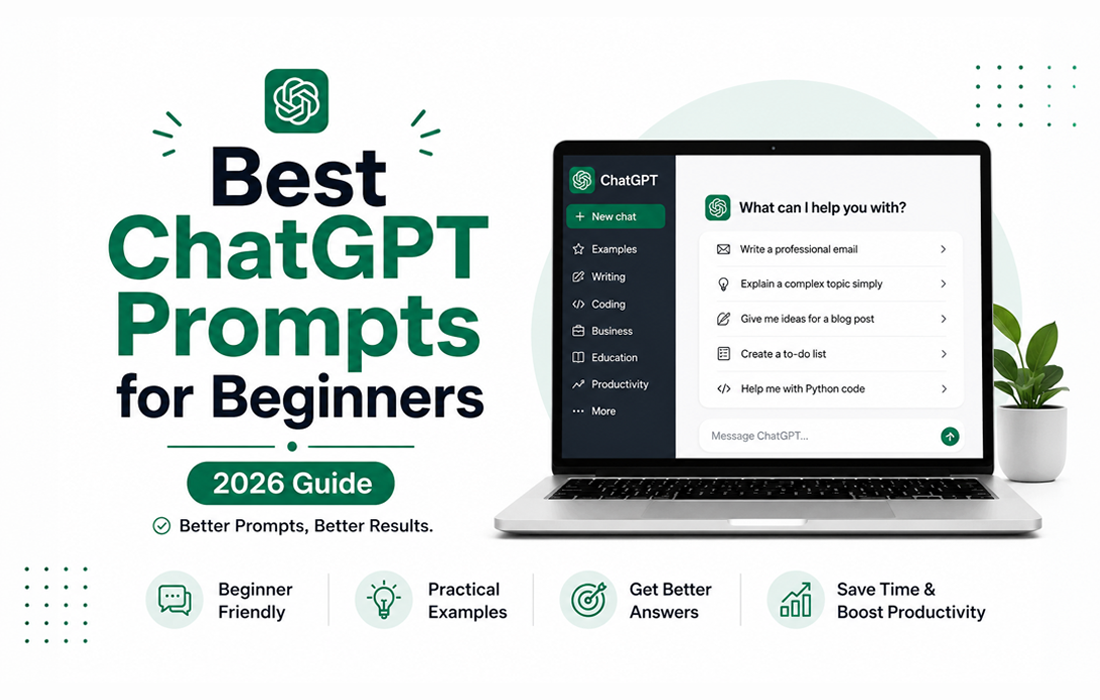
    Best ChatGPT prompts for beginners

    Best ChatGPT Prompts for Beginners

    The best ChatGPT prompts are clear, specific, and designed for a particular goal. Below are practical prompt examples for beginners, organized into different categories. Feel free to copy, customize, and use them for work, study, writing, coding, and everyday tasks.

    Writing

    Writing is one of the most popular uses for ChatGPT. Whether you’re creating emails, blog posts, social media captions, or reports, a well-written prompt helps generate better content in less time.

    • Write a professional email to a client who missed a meeting.
    • Rewrite this paragraph to sound more natural and engaging.
    • Write a blog introduction about artificial intelligence for beginners.
    • Create five Instagram captions for a coffee shop.
    • Summarize this article in under 100 words.

    Work

    ChatGPT can improve productivity at work by helping with reports, meeting notes, presentations, and professional communication. Clear prompts lead to more useful business results.

    • Write a professional meeting agenda for a 30-minute team meeting.
    • Summarize these meeting notes into key action items.
    • Create a project timeline for a website redesign.
    • Write a follow-up email after a business meeting.
    • Turn these bullet points into a professional report.

    Coding

    Whether you’re learning to code or solving programming problems, ChatGPT can explain concepts, debug code, and generate examples for many programming languages.

    • Explain Python variables for beginners.
    • Find the bug in this JavaScript code.
    • Write a simple HTML landing page.
    • Create a basic calculator using Python.
    • Explain what an API is with simple examples.

    Productivity

    Many people use ChatGPT to stay organized, manage their time, and improve productivity. It can help create schedules, prioritize tasks, and simplify daily planning.

    • Create a weekly to-do list based on these tasks.
    • Build a daily schedule for working from home.
    • Prioritize these tasks based on urgency.
    • Plan my week to improve productivity.
    • Suggest time management tips for busy professionals.

    Travel

    ChatGPT can help you plan trips, build travel itineraries, estimate budgets, and recommend places to visit based on your interests.

    • Plan a three-day trip to Tokyo with a budget of $500.
    • Recommend the best attractions in Paris.
    • Create a family travel itinerary for Seoul.
    • Suggest affordable hotels in New York.
    • Build a packing checklist for a summer vacation.

    Business

    Business owners can use ChatGPT for brainstorming, marketing, customer service, and planning. Well-crafted prompts can save time and generate fresh ideas.

    • Create a marketing plan for a new coffee shop.
    • Write a product description for an online store.
    • Suggest five business name ideas for an AI startup.
    • Create a social media content calendar.
    • Generate customer service email templates.

    A Practical Prompt Test: Vague vs. Structured

    Try the same task with these two prompts and compare how much editing the first response requires.

    Vague prompt:

    Write an email about a delayed project.

    Structured prompt:

    Write a professional email to a client explaining that a website redesign will be delayed by three business days. Briefly state the reason, explain the impact, give the revised delivery date, and offer a short next step. Keep the tone calm and accountable and the message under 150 words.

    The vague version leaves ChatGPT to guess the audience, tone, reason, timing, and desired action. The structured version defines those decisions before writing begins, so the result should be easier to review and adapt. This does not guarantee that every detail is correct: check names, dates, promises, and factual claims before sending or publishing the answer.

    How to judge the two results

    • Does the email clearly identify the audience and the purpose?
    • Does it include the delay, revised delivery date, impact, and next step?
    • Is the tone calm and accountable rather than defensive?
    • Does it stay under 150 words without omitting an essential detail?
    • Which names, dates, causes, or promises still require human verification?

    OpenAI’s official prompt engineering guidance for ChatGPT also recommends clear, specific instructions and iterative refinement. Treat the first response as a draft: review it, identify what is missing, and improve the next prompt instead of expecting one perfect result.

    If you repeat the same preferences across many conversations, learn how to set up ChatGPT Custom Instructions. For a deeper troubleshooting checklist, review these common ChatGPT prompt mistakes.

    Common Prompt Mistakes

    Even the best AI tools can produce poor results if the prompt is unclear. Here are some common mistakes beginners make and how to avoid them.

    Being Too Vague

    A prompt like “Tell me about business” is too broad. Instead, explain exactly what you want to learn or create. Specific prompts almost always produce better answers.

    Not Giving Enough Context

    Without context, ChatGPT has to guess what you need. Include your goal, audience, experience level, or any important details to receive more relevant responses.

    Asking Too Many Questions at Once

    Trying to solve multiple problems in one prompt can confuse the AI. Break large tasks into smaller prompts for clearer and more accurate responses.

    Not Asking Follow-up Questions

    Your first answer doesn’t have to be the final one. Ask ChatGPT to rewrite, simplify, expand, or improve its previous response to get better results.

    Frequently Asked Questions

    What is a ChatGPT prompt?

    A ChatGPT prompt is the instruction or question you give to ChatGPT. Clear prompts usually produce more accurate and useful responses.

    Can beginners use ChatGPT prompts?

    Yes. Anyone can use ChatGPT by writing simple instructions. You don’t need any technical knowledge to get started.

    How can I write better prompts?

    Be specific, provide enough context, choose your preferred format, and don’t hesitate to ask follow-up questions. The best ChatGPT prompts are clear, detailed, and written with a specific goal in mind.

    Do better prompts improve ChatGPT answers?

    Yes. Better prompts help ChatGPT understand your request more clearly, leading to more relevant and accurate responses.

    Can I copy these prompts?

    Absolutely. These examples are designed to help beginners learn how to write effective prompts. Feel free to customize them to fit your own needs.

    Final Thoughts

    Learning how to write the best ChatGPT prompts is one of the fastest ways to improve your AI experience. Small changes in your instructions can lead to dramatically better answers, saving time and producing more useful results.

    The examples in this guide are only the beginning. As you continue experimenting with different prompts, you’ll discover new ways to use ChatGPT for work, study, creativity, business, and everyday life.

    If your goal is learning, try these prompting ideas in ChatGPT Study Mode, which can guide you with questions, practice, and feedback instead of only giving you a finished answer.

    Start with these beginner-friendly prompts, adjust them to match your goals, and don’t be afraid to keep the conversation going. The more you practice, the better your prompts—and your results—will become.

    Now it’s your turn.

    Choose one prompt from this guide, try it in ChatGPT, and experiment with different styles and instructions. Every conversation helps you become more confident and more effective at using AI.

    Bookmark this guide and come back whenever you need new ChatGPT prompt ideas.

    Official ChatGPT